
When ChatGPT exploded in popularity, how we find information changed almost overnight. For years, discovery meant searching with keywords, comparing links, and navigating websites.
Today, more people are simply asking AI tools questions and receiving synthesized answers instantly. The shift from searching to asking has created a new reality for marketers — one where visibility is no longer determined solely by Google rankings.
How to Get Cited by AI (AEO in 2026)
AI search is shifting discovery from ranking pages to synthesizing answers. You can’t “rank” inside tools like ChatGPT, but you can increase the chances your content gets cited or referenced.
Here’s what matters:
- AI doesn’t rank — it selects trusted sources. Visibility now depends on credibility, structure, and authority, not just keyword position.
- Build trust first (E-E-A-T). Original insights, expert authorship, data-backed analysis, and real-world examples make your content more reference-worthy.
- Structure for extractability. Clear headings, concise explanations, tables, schema markup, and Q&A-style formatting help AI systems interpret and reuse your content accurately.
- Cover topics holistically. AI evaluates semantic depth, not isolated keywords. Build content ecosystems that address related questions and adjacent concepts.
- Strengthen brand authority beyond your site. Mentions, thought leadership, digital PR, and off-page credibility signals increase the likelihood AI associates your brand with expertise.
- Technical SEO still matters. Fast, structured, crawlable websites remain foundational for AI retrieval systems.
The Numbers Behind the Shift to AI Content Discovery
The behavioral change is measurable at global scale:
- ChatGPT reached 800 million weekly active users by October 2025, increasing from 500 million in March 2025.
- The platform processes over 2.5 billion queries per day, signaling sustained, repeat usage rather than novelty or experimentation.
- Monthly visits surpassed 5.7–5.8 billion in 2025, placing AI assistants among the most heavily used digital platforms.
- Seeking information, practical guidance, or writing comprises nearly 80% of ChatGPT usage.
- Google’s AI Overviews now reach more than 1.5 billion users every month, embedding AI directly into traditional search behavior.
- Generative AI adoption for content discovery grew 156% year-over-year, reflecting a rapid transition from keyword queries to conversational exploration.
- By 2028, organic search traffic will decline by up to 25% as AI assistants and generative search reshape discovery behavior.
- The global generative AI market size is expected to grow at a CAGR of 29.30% to reach USD 1,260.15 billion by 2034.
Forecasts suggest this trend will only continue: global AI tool users are projected to grow from 346 million in 2025 to over 424 million in 2026, with steep growth through the decade.
Naturally, this has led to confusion. If AI tools generate answers instead of displaying search results, how do brands “rank” in them? Is there such a thing as ChatGPT SEO? And what does it mean to optimize for platforms that don’t even have traditional results pages?
“You can’t rank in answer engines the way you rank on Google — but you can earn your place in the answer. The brands that win in AI search aren’t chasing positions; they’re building authority strong enough to be cited.”
– Tara Sundaram, Co-Founder, SeriesXMarketing
This emerging discipline is called Answer Engine Optimization (AEO), and it sits within a broader strategic shift known as Generative Engine Optimization (GEO).
AEO focuses specifically on earning citations inside AI-generated answers.
GEO (Generative Engine Optimization) is broader, it focuses on influencing how AI systems understand, describe, and position your brand across generative experiences.
Rather than replacing SEO, AEO builds on it, adapting content strategies so they remain visible in AI-generated responses.
This article explains how AI answer engines work and outlines the strategies B2B marketers must follow to ensure their content is surfaced — and cited — by tools like ChatGPT and other AI-driven platforms.
How AI Answer Engines Work
AI answer engines are fundamentally different from traditional search engines. Platforms such as ChatGPT, Google Gemini, Claude, Perplexity AI, and Microsoft Copilot do not simply retrieve pages and rank them in order.
They synthesize answers.
Under the hood, answer engines rely on several technical mechanisms that differ from traditional SEO ranking systems:
- Zero-click search behavior: Delivering answers directly without requiring a website visit
- Entity recognition: Identifying brands, authors, products, and concepts as structured entities rather than just keywords
- Query fan-out: Expanding a single user query into multiple related sub-questions to generate a comprehensive answer
- Passage-level content engineering: Extracting and ranking specific sections of content rather than entire pages
- Vector embedding-based retrieval: Matching semantic meaning rather than exact keywords using embedding similarity
- Probabilistic ranking: Selecting sources based on likelihood of relevance and trustworthiness rather than deterministic position
These same mechanisms underpin GEO strategies. While AEO optimizes for answer inclusion, GEO focuses on strengthening how your brand is modeled within AI systems, improving entity associations, contextual relevance, and narrative framing across generative responses.
Instead of returning ten blue links, they generate responses on the fly by combining pretrained knowledge with retrieved information from authoritative sources. This means the algorithm is no longer deciding which page ranks #1 — it is deciding which sources are credible enough to inform the answer.
Traditional SEO vs AEO vs GEO (How They Work Together)
| Dimension | Traditional SEO | AEO / LLMO (Answer Engine Optimization / Large Language Model Optimization) | GEO (Generative Engine Optimization) |
| Primary Goal | Rank higher on SERPs | Get cited in AI-generated answers like AI Mode | Influence AI-generated narratives and brand perception |
| Metrics | Rankings, CTR, impressions, traffic | AI citations, AI search share, answer inclusion rate | Brand mentions in generative outputs, entity association strength, answer relevance |
| Optimization Focus | Keywords, search intent, backlinks, on-page SEO | Authority, structure, extractability, semantic coverage | Brand authority, entity recognition, cross-platform presence, query-fan out |
| Engagement Signals | Searching and clicking SERP links to websites | Asking AI for synthesized answers (zero-click search impressions) | Conversational exploration and AI-assisted decision journeys |
| Competitive advantage | Rankings, Strong domain authority and link profile | Clear expertise and structured, reference-worthy content | Recognizable brand entities and ecosystem-wide authority |
Academic research analyzing millions of AI search outputs found a dramatic increase in AI-generated responses across real-world queries between 2024 and 2025, signaling a structural change in how information is delivered.
This is why marketers cannot “rank” in AI tools the way they rank on Google with SEO.
But they can be cited, sourced or referenced.
That practice is called Answer Engine Optimization (AEO).
Why AI Visibility Matters (Even if You Rank #1 on Google Already)
Search behavior is already shifting toward conversational discovery. 10-45% of total market queries are now processed by AI assistants.
Users increasingly rely on AI tools to summarize complex topics, compare solutions, and explain unfamiliar concepts before they ever visit a website.
This means that even strong organic rankings don’t guarantee visibility in AI-generated environments. If an AI platform synthesizes answers without referencing your content, your expertise may effectively disappear from the decision-making journey.
For SaaS marketers and B2B companies, this introduces a new competitive dynamic. Visibility is no longer confined to just search results pages; it now includes participation in AI-generated narratives. Companies that adapt can gain early trust signals, while those that ignore this shift risk losing influence despite strong SEO foundations.
From an AEO perspective, the goal is citation.
From a GEO perspective, the goal is influence — ensuring AI systems consistently associate your brand with key industry concepts, categories, and expertise areas, even when your website is not directly cited.
It is said that by 2028, traditional search traffic to websites will reduce by half as AI-generated results would replace direct clicks. 75% of Google searches will feature AI search and the majority of global daily queries will be handled by AI by 2028-2030.
At the same time, AI citations offer meaningful upside. When answer engines surface your ideas, they place your company at the center of the learning and discovery process. That exposure often occurs earlier in the buyer journey, when audiences are researching problems rather than evaluating vendors.
Even companies ranking in Google’s 20–40 positions, well outside traditional page-one visibility, still have a very real opportunity to be cited in AI search. Because answer engines prioritize clarity, authority, and relevance over simple ranking positions, smaller or emerging brands can effectively compete alongside larger incumbents in AI-generated responses.
How to Boost Content Discovery on AI Search
To increase the likelihood that your expertise is surfaced and cited, marketers need to move beyond traditional SEO tactics and intentionally optimize for how AI systems retrieve and synthesize information.
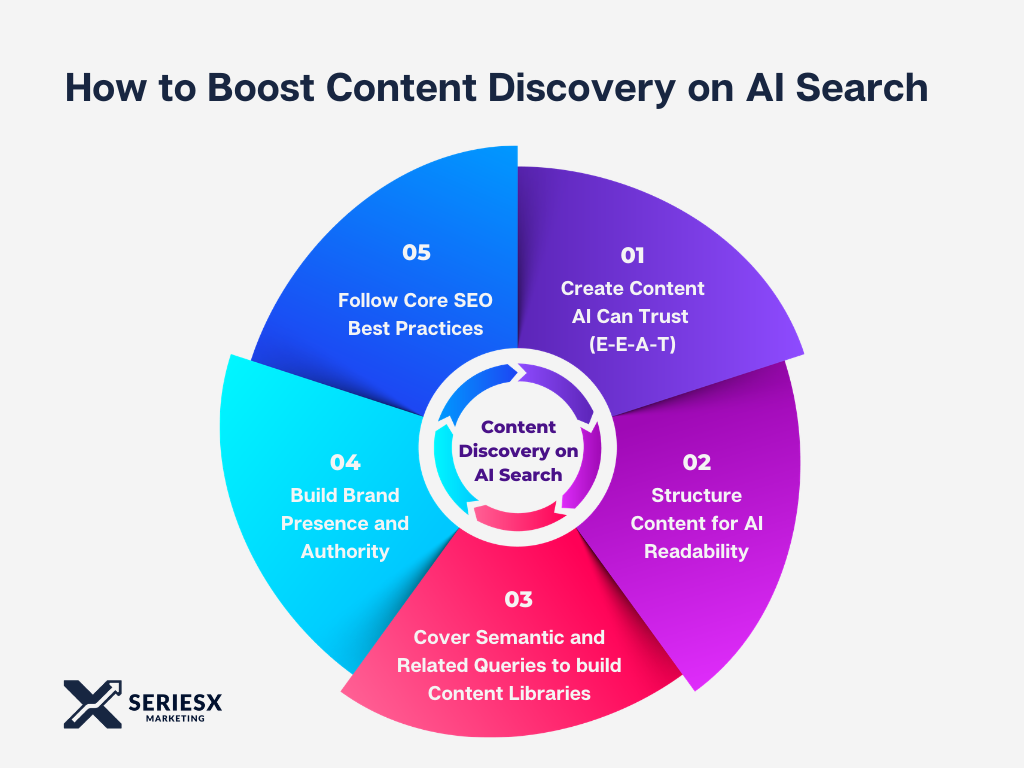
Step 1: Create Content AI Can Trust (E-E-A-T)
Trust is the foundation of AI search optimization. Large language models are designed to synthesize information responsibly, which means they lean toward content that demonstrates EEAT (Experience, Expertise, Authority, and Trust).
Content that simply rephrases common knowledge rarely performs well in this environment. Instead, AI systems gravitate toward material that shows evidence of expertise — whether through original research, entities such as persons/authors, real-world examples (testimonials, quotes and case studies), or well-supported analysis.
For marketers, this requires a shift away from surface-level content production. Articles should aim to answer questions comprehensively rather than just target keywords. Including statistics, original frameworks, or practical insights strengthens the informational value AI models rely on.
When assessing suppliers, 73% of decision makers prioritize thought leadership content more than marketing materials while 53% agree that if thought leadership is of high quality, brand recognition doesn’t matter that much.
SeriesX has long emphasized creating high-quality content that resonates with audiences, and that same philosophy aligns closely with how answer engines evaluate credibility. Clear, accurate writing supported by meaningful insights helps position content as a trusted source.
Another practical consideration is attribution. While AI responses may not display traditional backlinks, content that references reputable sources reinforces trust signals within the ecosystem AI models draw from. Demonstrating intellectual rigor, differentiation and first-party insights increases the likelihood that your material is synthesized into responses.
Step 2: Structure Content for AI Readability

AI systems do not consume content like human readers or the search bots looking to crawl and index content for ranking. They analyze structure, extract relevant segments, and reinterpret them contextually within the knowledge session. Because of this, formatting plays a significant role in ChatGPT SEO optimization.
Well-organized content — with clear headings, logical flow, and concise explanations — allows AI to identify where specific answers live on a page. Dense, unstructured writing may contain valuable insights but can be harder for models to interpret reliably.
SeriesX blogs often introduce ideas conversationally before defining them in structured sections. This approach not only improves reader engagement but also helps AI systems parse meaning effectively.
Short paragraphs, descriptive subheadings, tables, comparisons, rich schema (such as Article, Organization, Product/Service, How-To, Review, etc.) and clearly articulated definitions increase extractability. Including Q&A-style explanations can further improve discoverability because AI-generated answers frequently mirror that format.
Writing in direct language also helps. Conversational phrasing aligns with how users interact with AI tools, making it easier for models to match your content to real-world queries.
Step 3: Cover Semantic and Related Queries to build Content Libraries
Google has repeatedly confirmed that its systems are designed to understand intent and meaning, using technologies like BERT and MUM to interpret relationships between concepts rather than match exact terms.
Answer engines evaluate topics holistically rather than through isolated keywords. Optimizing for AI search means addressing a network of related questions and concepts, not just a single phrase.
This also improves query fan-out compatibility where AI systems expand a single user question into multiple related sub-queries and strengthens entity recognition, helping models clearly associate your brand, authors, and expertise with specific topics.
For instance, a discussion about “how to rank on ChatGPT” should naturally explore broader themes like AI search optimization, ChatGPT and SEO, AI optimization, and how AI search algorithms interpret authority. This semantic breadth signals that the content library provides comprehensive coverage of the topic.
SeriesX’s approach to uncovering search intent aligns with this requirement. By understanding how audiences phrase questions and what adjacent concerns they have, marketers can create content that feels genuinely informative rather than narrowly optimized.
Using natural language is especially important as conversational search continues to grow. AI tools are designed to respond to complete thoughts, not fragmented keyword strings, so content should mirror how people actually ask questions.
Providing concise explanations to related subtopics within the same article strengthens topical authority and increases the likelihood that answer engines treat the content as a reliable reference.
Step 4: Build Brand Presence and Authority
AI answer engines do not evaluate content in isolation. They draw signals from the broader digital environment to determine which sources appear credible and widely recognized.
This is where GEO becomes especially important. Generative models form probabilistic associations between brands and topics based on repeated co-occurrence across trusted sources.
Brands that are consistently mentioned across publications, reviews, industry platforms, directories, and professional communities create a stronger authority footprint. This reinforces the trustworthiness AI systems look for when deciding what information to include.
Off-page SEO remains essential here. Thought leadership articles, guest contributions, digital PR, reviews, listings, and social engagement all help build the contextual signals that support answer engine optimization.
SeriesX often highlights multi-channel content strategies because visibility compounds across platforms. When your expertise appears repeatedly in credible spaces, AI systems are more likely to associate your brand with authority on a subject.
Establishing identifiable authors and clear organizational expertise can also strengthen recognition due to entity patterns used by these AI systems. Content tied to experts or well-defined brands gives AI systems clearer context about who or what is providing the information and why it matters.
Step 5: Follow Core SEO Best Practices
Despite the rise of AI-driven discovery, foundational SEO remains critical. Google still retains roughly 90% of the global market share when it comes to query volume, amassing 15+ billion searches a day compared to ChatGPT’s tens of millions.
Answer engines frequently rely on traditional search infrastructure to access and validate information, meaning technical optimization still underpins visibility.
Ensuring fast load times, mobile responsiveness, clean robots.txt and llm.txt files, good site architecture, and accurate metadata helps make content accessible to both search engines and AI retrieval systems.
Structured data is particularly valuable. Schema markup — including FAQs, definitions, and how-to formats — provides explicit signals that help AI interpret context and extract answers efficiently.
SeriesX continues to emphasize these fundamentals because AI optimization cannot succeed without them. Strong technical SEO creates the conditions that allow answer engine strategies to function.
Monitoring performance is equally important. As AI search evolves, marketers should evaluate how their content surfaces across platforms and adjust strategies based on emerging patterns, much like ongoing SEO audits refine traditional search performance.
For AI answer engine optimization, B2B marketers are increasingly tracking AI search share, the number and quality of AI citations, and how often their content is selected as the source for answers. These AEO-specific metrics complement traditional SEO metrics such as click-through rate (CTR), impressions, and organic rankings, helping teams understand both visibility and influence across search paradigms.
AEO Checklist in Practice: What B2B Marketers Should Prioritize
If you strip this guide down to its essentials, here’s what actually moves the needle in AI search:
Making Your Expertise Discoverable by AI
AI-driven discovery is not replacing search — it is reshaping how trust is established online. Instead of scanning lists of links, users increasingly rely on synthesized answers to understand problems, evaluate approaches, and build shortlists before ever visiting a website.
In this environment, visibility is no longer defined solely by where you rank, but by whether your insights are included in the answers shaping buyer understanding.
Brands that focus only on traditional keyword performance risk becoming invisible during the earliest and most influential stages of research, while those that invest in authoritative, well-structured, and widely recognized expertise position themselves as part of the conversation AI is delivering.
Answer Engine Optimization is ultimately about producing content that deserves to be referenced. The material is grounded in real knowledge, supported by credible signals, and connected to the broader digital ecosystem. The companies that succeed with AEO will not be those publishing the most content, but those creating the clearest, most reliable explanations of their domain.
As AI interfaces continue to evolve, marketers must think beyond rankings and begin designing content ecosystems that reinforce authority across channels, formats, and audiences. The goal is no longer just to attract clicks, but to ensure your expertise informs the answers your customers are already asking for.
If you’re looking to adapt your content strategy for this shift, SeriesX Marketing helps B2B organizations build AEO/GEO programs designed for both search visibility and AI citation — ensuring your brand is not just found, but trusted as a source.