

Did you know that there are over 23+ roles you might need within a content marketing team?
If you are in the process of building your content team as a new marketing manager, GTM professional, or Director of Content in a growing SaaS startup, that’s a lot to consider!
To simplify things, we’ve narrowed it down to the 7 most crucial roles you might need to fill in your content team.
Of course, at any point, if it becomes too overwhelming to hire this talent in-house or manage scores of freelance writers, you can always rely on a trusted, content-focused marketing agency like SeriesX Marketing, who can be your one-stop shop to manage your content strategy, production, repurposing, and distribution needs across:
- all stakeholders
- billing
- agreements
(shameless plug 🙂)
In this blog, we’ll explore what each role entails and how you can effectively build your content team for your SaaS brand.
The Importance of a Well-Structured Content Team
50% of companies were expected to grow their content team in 2022. But skilled writers alone are not enough to create a watertight content strategy for your SaaS brand.
A well-organized content team is the foundation of every SaaS startup that has realized the potential of content as a growth lever for scale.
Your content needs to ensure that it –
- speaks to your target audience,
- is consistent with your messaging, positioning, and brand’s tone of voice, and
- produces real business results.
A cohesive team can help maximize your efforts and accelerate tasks such as planning, organizing, producing, editing, and distributing content.
Imagine a harrowed marketer spinning their wheels trying to balance content operations with marketing strategy.
Clearly outlining roles and responsibilities in a content team can help you reduce confusion, increase efficiency, and foster a collaborative working environment.
Even the most talented content professionals might struggle if they lack proper supervision and resources. They may get disorganized due to unclear goals, vague instructions, and a lack of support from their managers. This can result in misdirected content efforts, inconsistent messages, and ultimately, poor outcomes.
Investing in an organized content team is an investment in your company’s success. A dedicated team enables you to create amazing content that increases engagement, builds trust, and, ultimately, accelerates your SaaS business.
Building a Content Team Framework
Let’s talk about the factors you need to consider before determining what positions and how many people to hire for your team.
Assessing Your Resources: Budget, Time, and Expertise
It’s critical to assess your current resources and identify any gaps before building your content team. Here are some important questions to think about:
- What are your team’s current abilities and expertise? Are there any particular areas that need to be filled, or are there any areas where you have a plethora of experience?
- What content assets do you already own? Are there any blog posts, white papers, case studies, or other content pieces in your library that you could use?
- What is your content creation budget? How much budget do you have for employing new team members or outsourcing content production to an agency?
- What is your content production timeline? Do you need content produced on a daily, weekly, or monthly basis?
Defining Your Content Goals: What Do You Want to Achieve?
Once you’ve evaluated your present resources, it’s time to determine your content requirements. Understanding your business goals, identifying the types of content you need to develop to support those goals, and determining the frequency and scope of content production are all part of this process.
- What are your overall SaaS business goals? Are you looking to raise brand exposure, increase revenue (ARR), generate MQLs, or enhance customer retention?
- What kind of content do you need to create? Are you looking for blog posts & articles, long-form assets such as ebooks and whitepapers, website landing pages, social media content, or others?
- Who is your intended audience? What kind of content will appeal to them and fulfill their requirements across their buying journey?
- How often should you publish content? Do you require content every day, every week, or every month?
- What is your content’s scope? Do you require content that is long form/short form or matches a certain stage of the buying process (TOFU/MOFU/BOFU)?
Answering these questions will help you create a clear content strategy that corresponds with your business goals and satisfies the needs of your target audience.
Choosing the Right Team Structure
You have 3 main options when deciding the structure of your content team:
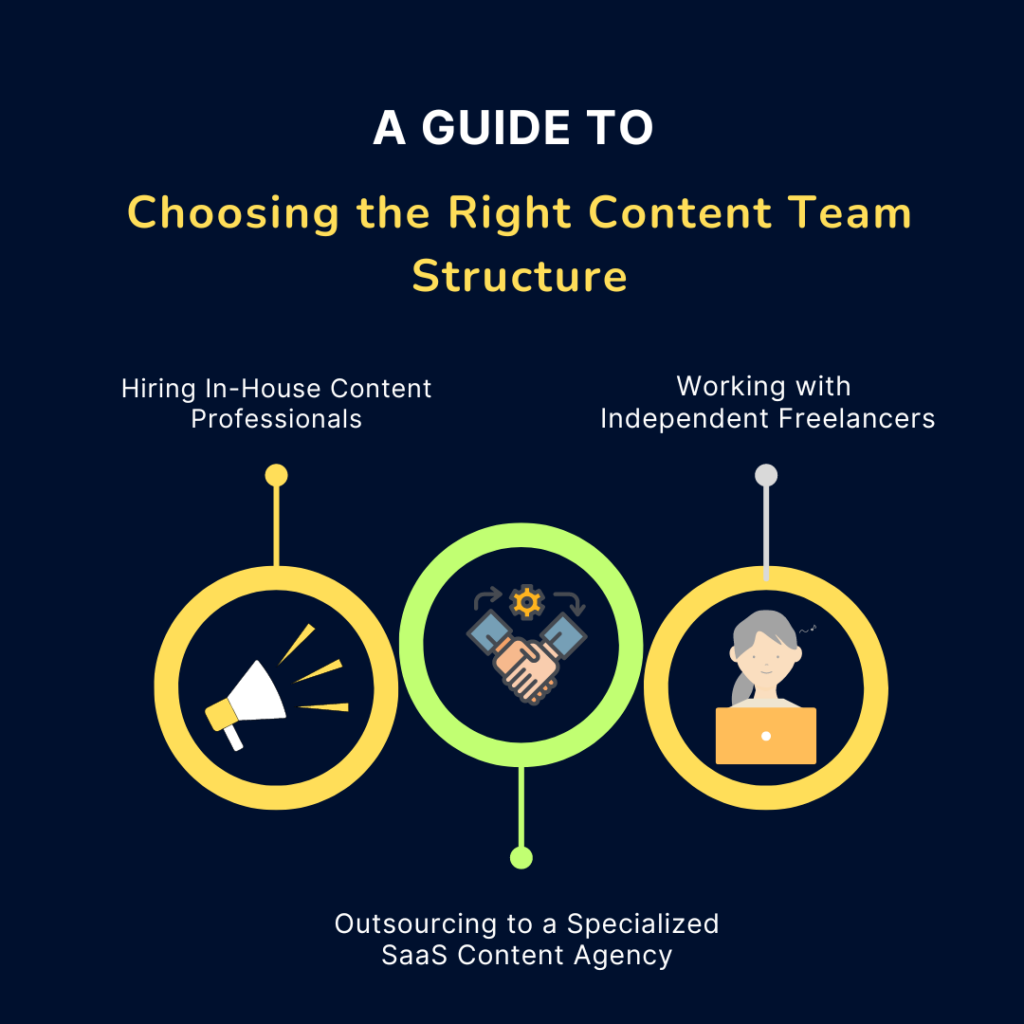
Hiring in-house content professionals/copywriters
|
Hiring in-house content professionals |
|
|
Benefits |
Considerations |
| Brand consistency: Ensures a unified voice and tone across all content. | Cost: Requires significant upfront investment in salaries, benefits, and equipment. |
| Control: Provides direct oversight over quality, timelines, and strategic direction. | Time: Hiring and onboarding can be a lengthy process. |
| Long-Term Investment: Cultivates a team with deep understanding of the brand and its audience. | Scalability: May be challenging to adjust staffing levels quickly in response to changing needs. |
| Company Culture: Contributes to a strong content culture within the organization. | |
Working with freelance content writers
|
Working with freelance content writers |
|
| Benefits |
Considerations |
| Flexibility: Allows for scaling up or down based on specific project requirements. | Quality Control: Requires careful vetting and management to ensure consistent quality. |
| Cost-effectiveness: Can be more affordable for smaller projects or short-term needs. | Communication: Effective communication and project management are essential to maintain alignment. |
| Access to Diverse Talent: Provides access to a wide range of specialized skills and expertise. | Ownership: May lead to a lack of long-term ownership or commitment to the brand. |
Outsourcing to a Specialized SaaS Content Agency
|
Outsourcing to a Specialized SaaS Content Agency |
|
| Benefits |
Considerations |
| Comprehensive Solutions: Offers a full suite of content services, including strategy, creation, and management. | Cost: May be more expensive in the long run, especially for large-scale content needs |
| Expertise: Provides access to a team of experienced professionals with deep industry knowledge. | Control: Requires a certain level of trust and reliance on the agency’s expertise. |
| Efficiency: Streamlines the content creation process and simplifies project management. | Alignment: Ensuring alignment between the agency’s goals and the brand’s objectives is crucial |
| Scalability: Can easily adapt to changing needs and scale up or down quickly. | |
Finding Your First Content Writer(s)
The allure of a single, all-encompassing content creator is understandable. But relying on just one person creates a single point of failure and hinders long-term growth. Here’s why building a small content team is a smarter strategy:
- Resilience: A single writer means one sick day can stall your content production.
- Scalability: You’ll face limitations in volume and diversity of content with only one writer.
- Skill Development: Building a team fosters collaboration, encourages learning different writing styles, and helps solidify editorial processes.
- Adaptability: A team can tackle both formulaic and creative content needs, allowing you to adapt to content marketing trends.
So, how do you approach building your content team?
Start small, grow smart.
Hiring multiple freelance writers or a content marketing agency in the early days allows you to test different styles and build your content voice without a full-time commitment. This is especially beneficial for smaller teams with limited resources.
Freelancers vs. Agencies:

Remember:
- Freelancers are ideal for adding content volume with a smaller team and accessing diverse writing styles.
- Content marketing agencies are ideal for rapid scaling, outsourcing your entire content pipeline to free up internal marketing resources.
By building a strong foundation with a well-defined team structure, you’ll be well on your way to developing a successful content marketing plan that drives results.

Level 1: Building a Content Team of 1-5 people
1. Content Writer(s)
Option 1: In-House Copywriters
Benefits:
- Brand Consistency: In-house writers can deeply understand and maintain a consistent brand voice and tone across all content.
- Company Knowledge: They have firsthand access to company goals, values, and culture, ensuring content aligns with the organization’s mission.
- Collaboration: In-house writers can directly collaborate with other team members, fostering better communication and understanding.
- Long-Term Investment: Hiring in-house writers can be a long-term investment in building a strong content team and company culture.
Challenges:
- Limited Flexibility: Hiring in-house writers can be less flexible, especially for smaller projects or fluctuating content needs.
- Higher Costs: Salaries, benefits, and overhead costs can be higher compared to freelancers.
- Creative Stagnation: Over time, in-house writers might experience creative burnout or become too familiar with the brand’s style.
Option 2: Freelancers
Benefits:
- Cost-Effectiveness: Freelancers can be more cost-effective for smaller projects or short-term needs, as you only pay for the work done.
- Specialized Skills: You can access a wide pool of talented freelancers with specialized skills in various niches in SaaS, such as MarTech or HRTech.
- Flexibility: Freelancers offer flexibility in scaling up or down your content team based on project requirements.
Challenges:
- Quality Control: Ensuring consistent quality and style can be challenging when working with multiple freelancers.
- Project Management: Managing freelancers requires effective communication and project management skills.
- Lack of Ownership: Freelancers may not have the same level of commitment or ownership as in-house writers.
Ultimately, the best choice for your organization will depend on your specific needs, budget, and team dynamics. Consider factors such as project scope, in-house expertise, timelines, and desired level of control when making your decision.
2. Content Marketing Manager (Internal)
The content marketing manager oversees the overall content strategy and execution. Their responsibilities include:
- Developing Content Strategy: Creating and implementing a comprehensive content marketing strategy aligned with business objectives.
- Keyword, Audience and Competitive Research: Identifying relevant keywords and topics being searched for by the target audience, along with competitive insights.
- Content Planning: Creating and managing an editorial content calendar.
- Content Creation: Producing high-quality content that aligns with the target audience’s needs and supports the business goals
- Content Distribution: Promoting content through various channels, including social media, email marketing, and public relations.
- Analytics and Measurement: Tracking content performance and making data-driven decisions.
- Project Management: Setting processes and managing the content operations workflows for seamless collaboration and execution.
- Team Management: Overseeing the content team, including content creators and editors.
3. Content Production Agency (External)
A SaaS content agency is one that specializes in creating high-quality content for SaaS businesses. Ideally it should include SEO optimization baked into its processes rather than as an afterthought or as a separate service. Their services typically include:
- Content Strategy Consultation: Providing guidance on content strategy, planning and audits.
- Content Creation Scope: Producing various types of content, such as blog posts & articles, landing pages, ebooks, whitepapers, case studies, and social media posts.
- Access to Experienced Content Writers: Access to a readymade pool of content writers with diverse knowledge and experience in SaaS niches.
- SEO Optimization: Conducting keyword research, optimizing on-page SEO elements, and building a solid foundation for technical SEO.
- Project Management: Managing the content production process from start to finish.
- Human writing and editing: High-quality content without reliance on AI.
Bonus Tip: Along with building a strong content team, it’s crucial to have a robust content tech stack to streamline your workflow and maximize efficiency. Check out our blog post: “25 Must-Have Content Marketing Tools For Your Tech Stack,” for a comprehensive list of essential tools to consider.
Level 2: Key Roles for a Growing Content Team (5+ people)
4. More Content Writer(s)
As your content strategy expands and evolves, it’s essential to have a diverse and growing pool of talented content writers. This ensures a steady stream of high-quality content, prevents bottlenecks, and allows you to scale your efforts effectively.
The importance of a diverse team:
- Variety of Perspectives: A diverse team of writers can offer unique perspectives and ideas, enriching your content.
- Adaptability: A team with diverse backgrounds can adapt to different subjects, niches and genres.
- Audience Reach: A diverse team can help you connect with a wider audience and avoid biases.
5. Digital Marketer (SEO and Social Media)
Combining SEO and Social Media expertise can significantly enhance your content marketing efforts. A digital marketer who is proficient in both areas (ℼ shaped marketer) can optimize content for search engines while driving engagement and reach through social media channels.
Key Responsibilities
SEO Optimization
- Conduct in-depth keyword research to identify relevant terms and phrases.
- Optimize website content for search engines, including meta tags, headers, body copy, internal and external links, and images.
- Perform technical SEO audits to ensure search engine crawlability and improve website performance.
- Develop and implement effective link-building strategies.
- Track and analyze content performance using SEO analytics tools.
Social Media Management
- Oversee and manage your brand’s social media presence across various platforms.
- Create engaging social media content that aligns with your brand’s voice and goals.
- Actively engage with your audience by responding to comments and building relationships.
- Develop and execute social media advertising campaigns to reach a wider audience.
- Analyze social media metrics to measure performance and identify optimization opportunities.
By combining these skills, a digital marketer can:
- Improve organic search visibility: Increase your website’s ranking in search engine results pages (SERPs).
- Drive social media engagement: Foster stronger connections with your audience and increase brand awareness.
- Maximize content reach: Promote your content through both search engines and social media channels.
- Optimize marketing efforts: Make data-driven decisions based on insights from SEO and social media analytics.
6. Graphic Designer
A graphic designer is invaluable for creating visually appealing supporting content that captures attention and enhances your SaaS brand’s identity. Their responsibilities include:
- Visual Content Creation: Designing blog graphics, supporting charts and images, infographics, and other visual assets to complement written content.
- Brand Consistency: Ensuring that all visual elements align with your brand’s guidelines and style.
- Content Enhancement: Creating visually engaging content that improves user experience and increases engagement.
- Social Media Graphics: Designing eye-catching graphics including images, carousels, slideshows, and videos for social media posts.
- Website Design: Contributing to the design and layout of your website and landing pages.
7. Content Editor

A dedicated content editor plays a crucial role in ensuring the quality and consistency of your content once you’ve scaled with multiple content writers. Their responsibilities include:
- Adherence to content briefs: Uses their high attention to detail to verify that all drafts follow the content brief and approved outlines
- Proofreading and Editing: Carefully reviewing content for grammar, spelling, and punctuation errors.
- Fact-Checking: Verifying the accuracy of information and data by collaborating with your product and success teams.
- Ensuring Brand Consistency: Maintaining a consistent tone, style, and voice throughout your content to comply with your brand’s style guidelines.
- Improving Clarity and Readability: Making suggestions to enhance the clarity and readability of content with good storytelling and hooks.
(Bonus) Level 3: 2 Additional Roles to Take Your Content to the Next Level
8. Go-to-Market (GTM) Pods
Did you know?
Only 8% of content marketers think the wider GTM org has an excellent understanding of content marketing. But 19% of non-content marketers think they have an excellent understanding.
Collaborating with other teams within your organization can help you create more effective and targeted content. Consider forming GTM pods that include the below:
- Sales Leads: Gain insights into customer needs, pain points, sales objections, and buying behaviors.
- Product Marketers/Managers: Understand product roadmap, features & benefits and align them with your target audience.
- Customer Success/Support Teams: Gather feedback from customers and identify areas for improvement.
By working together, you can:
- Create Content that Aligns with Business Goals: Ensure your content supports your sales and marketing objectives.
- Tailor Content to Target Audiences: Develop content that resonates with specific customer segments.
- Improve Content Effectiveness: Incorporate customer feedback and product insights to enhance content quality.
- Foster Cross-Functional Collaboration: Break down silos and improve communication between teams such as marketing, sales, product and success.
- Drive Better Business Results: Achieve greater alignment between content and overall business strategy, and get a seat at the table.
9. PR Professional/Agency
A PR professional or agency can significantly amplify your content’s reach and visibility by:
- Securing Media Coverage: Pitching your content to relevant media outlets and securing press mentions.
- Managing Media Relations: Building and maintaining relationships with journalists and influencers.
- Crisis Management: Developing strategies to address potential PR crises and mitigate their impact.
- Reputation Management: Protecting and enhancing your brand’s reputation through targeted PR efforts.
- Event Planning: Organizing press events, conferences, or webinars to generate media attention.
- Thought Leadership: Positioning your brand as an industry expert through thought leadership pieces such as reports and whitepapers, and speaking engagements.
By investing in these bonus roles, you can truly scale your content marketing efforts, expand your reach, and drive significant business results.
Common Challenges Faced by Content Teams
Content managers often grapple with the decision of whether to build an in-house content team or outsource content creation. Each approach presents distinct advantages and challenges that must be carefully considered based on specific business needs.
We’ve outlined key points to consider before deciding whether to hire in-house or outsource to a content creation companies:
|
Factor |
Hiring in-house |
Outsourcing to an Agency |
|
Control |
High control over content creation and brand consistency | May have less control over content creation |
| Cost | Higher upfront costs for hiring and training | Lower upfront costs, but potential for ongoing expenses |
| Talent Acquisition | Challenging to find and retain top talent | Access to a global and diverse talent pool |
| Time Commitment | Significant time investment in hiring, training, and management | Less time commitment for hiring and management |
| Brand Consistency | Greater control over brand voice and messaging | Potential for variations in style and tone |
| Knowledge Sharing | Deep product and industry knowledge within the team | May require additional training or onboarding |
| Flexibility | Less flexibility to adjust team size and roles | More Flexibility and Scalability |
| Communication | Faster communication and collaboration within the team |
Potential for communication challenges across different time zones and cultures |
Strategies for Overcoming Content Challenges
- Clear Expectations and Guidelines: Establish clear guidelines for content creation, including briefs, style guides, tone, and target audience.
- Regular Communication and Feedback: Maintain open communication channels and provide regular feedback to ensure alignment.
- Utilize Collaboration Tools: Leverage tools like project management software and shared document platforms to facilitate collaboration.
- Conduct Regular Content Audits: Monitor content quality and make necessary adjustments.
- Consider Hybrid Approaches: Combine in-house and outsourced resources to balance control and cost-efficiency.
Ultimately, the decision between hiring in-house or outsourcing depends on your specific business needs, budget constraints, and desired level of control. Carefully consider the advantages and disadvantages of each approach to determine the best fit for your SaaS content strategy.
Your Path to SaaS Content Success starts here.
Building a powerful content marketing team is a journey that requires careful planning, strategic hiring, and effective management. By focusing on essential roles, fostering a strong team culture, and remaining adaptable, you’ll be well-equipped to create compelling content that resonates with your audience and drives business results.
Remember, there’s no one-size-fits-all approach to building a content team. Tailor your team structure to your specific needs and goals, and don’t be afraid to experiment and adjust as you grow.
SeriesX Marketing is here to support your SaaS growth story. Our team of experienced marketing professionals can provide the expertise and resources you need to:
- Develop a winning content strategy
- Create high-quality, engaging content
- Optimize your content for search engines
- Measure and analyze your content’s performance
- Scale your content marketing efforts
Ready to take your SaaS content to the next level? Contact us today to book a free discovery call.