
TL;DR
- Retrieval isn’t citation: Ahrefs found ChatGPT cited only ~50% of the URLs it retrieved across 1.4M prompts.
- Brand-owned content is the smallest citation category at 13%, behind reference sources (18%), community/forums (16%), and news/media (15%).
- Reddit’s citation share is highly volatile — it fell 86.4% in a matter of weeks, per Promptwatch.
- OpenAI runs three separate crawlers (OAI-SearchBot, GPTBot, ChatGPT-User), and only OAI-SearchBot helps you answer: “what websites does ChatGPT crawl” in search answers.
- AI citations reward content that’s structured for extraction: direct answers, question-based headings, and self-contained sections.
- No single platform or website is a guaranteed citation lever for ChatGPT — diversify your sources across owned, reference, community, and earned media.
- Citation patterns shift fast enough that tracking needs to be ongoing activity
ChatGPT SEO is the practice of structuring, distributing, and technically preparing your content so ChatGPT can easily extract, retrieve and cite you in its AI search answers. It sits alongside AI search optimization, answer engine optimization (AEO), and generative engine optimization (GEO). If you’ve been searching for how to get cited by ChatGPT, this is the place to start.
The catch is that retrieval and citation are different events. Ahrefs’ analysis of 1.4 million ChatGPT prompts found that ChatGPT cited only about 50% of the URLs it retrieved. Entering ChatGPT’s retrieval pool doesn’t guarantee a citation. ChatGPT source selection is a distinct, further step.
Citation patterns also shift fast. Reddit’s share of ChatGPT citations has swung sharply in recent months, a reminder that a ChatGPT search optimization plan built on one platform could backfire.
What Is ChatGPT SEO?
ChatGPT SEO (also called ChatGPT AI search or ChatGPT search optimization) means earning two things in sequence:
- Retrieval: ChatGPT finds your page and adds it to the candidate pool for a query. This requires crawlable, indexable, relevant content.
- Selection: ChatGPT picks which candidates to cite, based on how clear, credible, and directly responsive each one is.
Most AI search optimization writing conflates these two steps into one “how to rank on ChatGPT” checklist. But the Ahrefs retrieval-vs-citation gap above shows they’re governed differently. Understanding how ChatGPT chooses sources, and specifically how ChatGPT chooses which sources to cite once a page is already retrieved is the real question behind most “how to rank in ChatGPT” searches. A page can pass step one and fail step two.
Technical eligibility comes first. Before content quality or structure matters at all, OpenAI’s crawlers need to actually be able to reach your pages. OpenAI operates three distinct crawler agents, and each one does a different job:
| Crawler | Purpose | Honors robots.txt | Why it matters |
| OAI-SearchBot | Builds the index that ChatGPT search retrieves from and cites | Yes | Sites opted out of it won’t appear in ChatGPT search answers |
| GPTBot | Collects public content that may be used to train OpenAI’s models | Yes | Blocking it doesn’t affect search visibility |
| ChatGPT-User | Fetches a specific page when a user asks ChatGPT to open it | robots.txt rules may not apply | Serves live, user-requested fetches rather than discovery |
Allow OAI-SearchBot explicitly, even if you restrict GPTBot for training reasons. This crawler layer is also the clearest answer to how ChatGPT Search works end to end: find, filter, then select.
| To keep your pages fresh enough to earn citations over time, see our guide to Content Velocity. |
ChatGPT AI Search vs. Traditional Google SEO
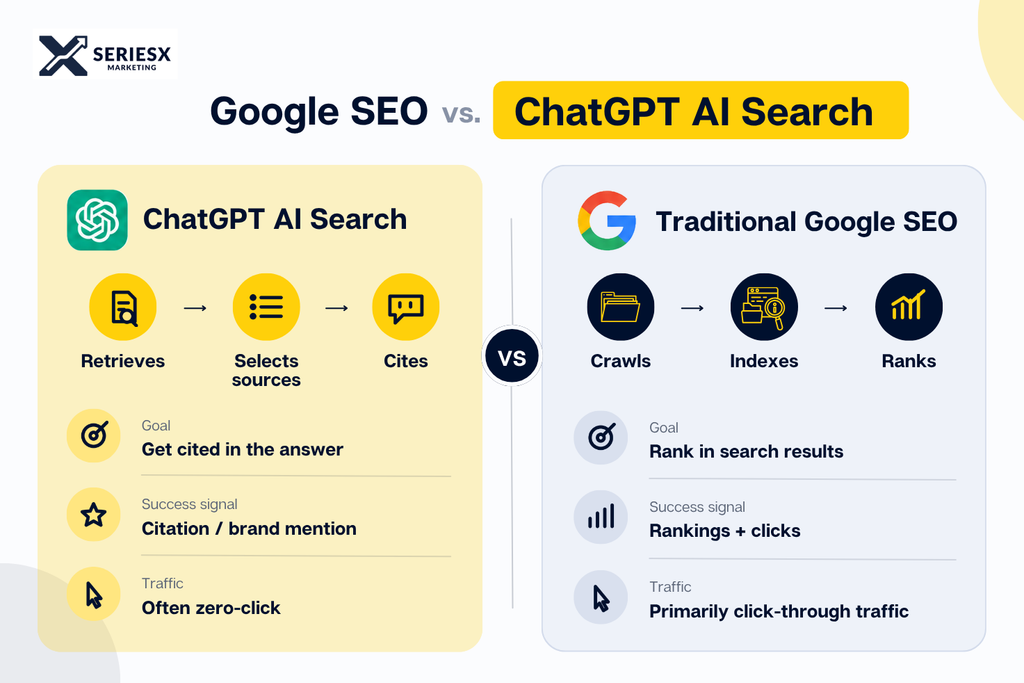
| Dimension | ChatGPT AI Search | Traditional Google SEO |
| Primary goal | Get cited inside a generated answer | Rank a page in a list of links |
| Success signal | Citation in the answer text | Ranking position on the SERP |
| Discovery mechanism | OAI-SearchBot retrieval, then a separate citation-selection step | Crawling, indexing, ranking |
| Content favored | Direct, extractable answers; reference and community sources | Comprehensive pages with keyword relevance and backlink authority |
| Brand-owned content share | Smallest source category | Can dominate branded and transactional queries |
| Volatility | High: category share can swing sharply in weeks | Slower-moving, though updates still cause swings |
| Traffic outcome | Often zero-click | Click-through and rankings are the primary outcomes |
ChatGPT Search vs. Other AI Search Engines
For a full breakdown of how each platform sources and ranks content, see our dedicated guides, linked below:
| Platform | Primary Crawler(s) | Key Source Types Favored | Dedicated Guide |
| ChatGPT Search | OAI-SearchBot, GPTBot, ChatGPT-User | Reference/encyclopedic, community/forums, news, general web search | This guide |
| Google AI Search (AI Overviews & AI Mode) | Googlebot | YouTube, Reddit, LinkedIn, Wikipedia, official/brand sites, backlinks from news sites and publishers | Google AI Search Optimization |
| Bing Copilot AI Search | Bingbot | First-party sites, reference sources (Wikipedia, Wikidata), community platforms (Reddit, Quora), editorial/media | Bing AI Search |
Does ChatGPT Cite Wikipedia, Reddit, and Quora More Than Other Sources?
Ahrefs’ July 2026 citation tracking put Reddit at 16.7% of ChatGPT’s tracked citation share and Wikipedia at 8.9%. But that figure describes the behavior till recently, not necessarily a leading indicator of how ChatGPT picks authoritative sources.
More recent research tells a very different story. Promptwatch data reported by Axios showed Reddit’s share of ChatGPT Search citations falling from 3.83% (July 18–Aug 7) to 0.52% by Aug 14–17: an 86.4% drop in roughly a month. Whatever caused that change, be it a ranking or retrieval update on OpenAI’s side, a shift in how Reddit content was weighted, or something else entirely, the practical lesson is the same: a single platform’s citation share can collapse far faster than most content calendars move.
So, does ChatGPT use Reddit, specifically? Yes, but its share has been dropping recently as mentioned above. Does ChatGPT use Quora? It does, but at a much smaller, less-tracked scale than Reddit or Wikipedia.
| The takeaway for anyone building a ChatGPT SEO or AI search visibility strategy: different source types can have outsized visibility for specific query types and specific windows of time, but no single platform is a guaranteed or permanent citation channel. Build a presence across source types instead of betting the strategy on one. |
What Sources Does ChatGPT Actually Use for Citations?
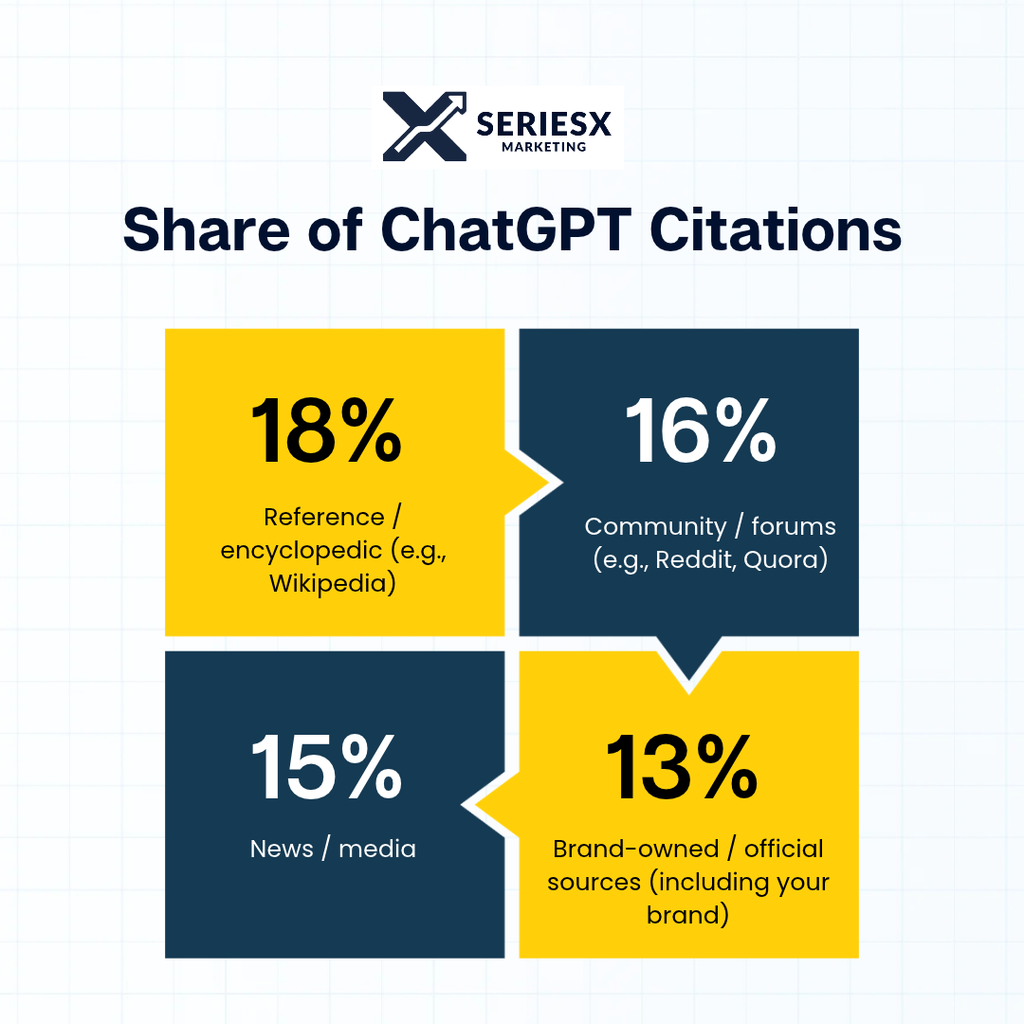
Indexly’s Jun 2026 buyer-intent panel breaks ChatGPT’s citations down by source type, a useful answer to what websites does ChatGPT cite most consistently across categories, beyond any single domain:
| Source Type | Share of ChatGPT Citations |
| Reference / encyclopedic (e.g., Wikipedia) | 18% |
| Community / forums (e.g., Reddit, Quora) | 16% |
| News / media | 15% |
| Brand-owned / official sources (including your brand) | 13% |
The pattern you’ll notice here: brand-owned and official content is the smallest of these four categories. ChatGPT does not default to citing companies talking about themselves. It leans on reference material, community discussion, and independent media before it leans on brand-owned pages.
This is reinforced by a second, structural stat from Ahrefs: 88.46% of ChatGPT’s cited URLs came through its general search ref_type, versus 12.01% for news, 1.93% for Reddit, 0.51% for YouTube, and 0.40% for academia. These ChatGPT search sources span a much wider pool than most GEO advice accounts for.
Read alongside the source-type table, this tells you two things at once:
- First, ChatGPT’s citation ecosystem is much broader than the “Wikipedia, Reddit, Quora” shorthand suggests and general web search results dominate.
- Second, within that broader pool, reference and community content still outperforms brand-owned content on a like-for-like basis.
How to Optimize for ChatGPT SEO (An Actionable Framework)
Everything above establishes what ChatGPT does to cite pages as a source. This section is about what to actually do differently in your B2B content operation to be cited easily by ChatGPT.
1. Build presence on reference and community platforms, not just owned channels
Since brand-owned sources account for the smallest share of citations (13%, per Indexly) and reference and community sources combined account for a larger 34%, your ChatGPT search optimization plan can’t stop at your own domain.
That means looking closely at the below:
- Wikipedia: pursue an entry only where your brand or product genuinely qualifies. Thin, promotional pages get removed and don’t help.
- Reddit and Quora: answer real questions in category threads instead of promotions disguised as posting. Given Reddit’s volatility, treat this as one input, not the centerpiece.
- Earned media: trade press and news coverage feed the 15% news/media share, and most brands underinvest here with their PR efforts.
- Owned content: 13% isn’t zero. Keep investing, but as one channel in a portfolio.
2. Structure and restructure content for AI search
Retrieval-stage crawlers and citation-stage selection both reward content that’s easy to parse and extract.
In practice, this means:
- Lead every section with a direct one- or two-sentence answer, then add context.
- Use question-based H2s and H3s that mirror how people phrase queries (“Does ChatGPT cite Reddit?” rather than “Reddit and Citation Dynamics”).
- Put statistics, comparisons, and process steps in tables and lists. Structured data is easier to extract accurately than a dense paragraph.
- Keep every section self-contained. A snippet lifted from halfway down the page still has to make sense on its own.
- Refresh older pages with these patterns. Restructuring existing high-value content often beats publishing new pages.
3. Follow content marketing best practices that improve citation potential
Beyond structure, the substance of the content needs to earn the citation:
- Back claims with named studies, datasets, and dates instead of vague assertions. Verifiable content is easier to cite than generic commentary.
- Update statistics on a visible cadence and show update dates. Numbers from two years ago read as stale to people and retrieval systems alike.
- Write for the reader, not the algorithm. Keyword-stuffed prose makes a weaker answer than clear, direct writing.
- Write sentences and paragraphs that survive being quoted out of context, since that’s exactly what a citation does.
4. Diversify beyond a single source type: no single platform dominates citations
Reddit’s slide from 3.83% to 0.52% in a matter of weeks is the strongest argument in this dataset against single-platform AEO and GEO. A plan that says “win at Reddit” carries a single point of failure that already failed once in 2026.
Instead, spread effort across:
- Owned content (your site, optimized per the structure guidance above)
- Reference platforms (Wikipedia, industry glossaries, established knowledge bases)
- Community platforms (Reddit, Quora, relevant forums — participated in, not just posted to)
- Earned media (trade press, journalist coverage, guest contributions to established outlets)
No category above should be your entire strategy. The data across every stat in this article points to the same direction: distribution, not concentration.
5. Monitor citation patterns and update your strategy
Because citation share can move as fast as the Reddit example shows, treat AI search visibility as something to track on an ongoing basis, not something you set once and revisit annually:
- Check your brand’s AI citations in ChatGPT answers for core queries on a recurring schedule, like weekly.
- Watch third-party trackers (Ahrefs, Indexly, Promptwatch) for shifts in which source types are gaining or losing share.
- Re-audit OAI-SearchBot access after any CDN or infrastructure change from your developers. A misconfigured block can easily remove you from eligibility.
- Treat every stat in this space, including the ones here, as a snapshot.
The ChatGPT Citation Factors That Matter Most
If you only take three things away from this ChatGPT AI search guide, let them be these:
- Retrieval ⇏ citation. ChatGPT only cited about half of the URLs it retrieved across 1.4 million analyzed prompts (Ahrefs).
- Brand-owned content is the smallest citation category, at 13% versus 18% for reference sources and 16% for community/forums (Indexly).
- Citation share can collapse fast. Reddit’s share of ChatGPT Search citations dropped 86.4% in about a month (Promptwatch/Axios) — proof that no single-platform GEO bet is safe long-term.
Building real AI visibility across reference platforms, community spaces, earned media, and well-structured owned content, rather than chasing whichever platform is trending in citation-tracker data this quarter, is the difference between a ChatGPT SEO strategy that holds up and one that’s built on a stat that expires next month.
Where SeriesX Marketing comes in
This is exactly the kind of work we do for B2B tech companies — building content that is structured to hold up whether you’re cited in ChatGPT, surfaced in an AI Overview, or grounded in Copilot.