


TL;DR
- Bing AI search now leaves a measurable citation trail through Bing Webmaster Tools’ AI Performance reporting: citations, cited pages, grounding queries, and page-level visibility.
- Copilot citation visibility is highly concentrated: one 91-day analysis found a single page responsible for 69% of all citations across an 86-page set.
- Deep sameAs entity schema markup lifted citation share by 34% overall across six AI engines — and by 52% specifically on Bing and Gemini.
- Copilot draws from a mix of first-party sites, reference sources (Wikipedia, Wikidata), community platforms (Reddit, Quora), and editorial/media sources.
- IndexNow helps Bing register content changes faster, supporting the freshness and retrievability that grounding systems look for.
- Because citation activity clusters on individual pages, page-level monitoring, not domain-level reporting, is what tells you where to focus optimization next.
Bing AI search, also referred to as Bing AI SEO, describes the citation-based retrieval layer integrated into Bing and Microsoft Copilot, in which generated responses are substantiated by evidence retrieved from indexed web content, rather than determined solely through page ranking. For years, “Bing SEO” meant one thing: ranking, getting clicks, moving up the SERP, much like on Google.
That’s no longer the current picture.
Source: https://blogs.bing.com/
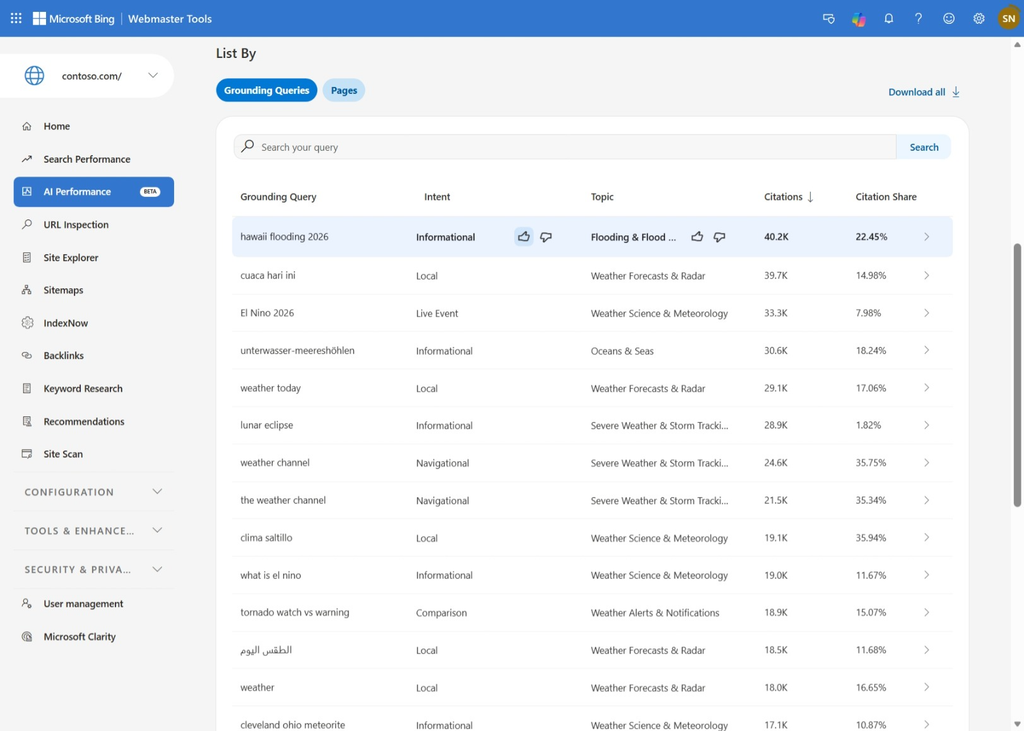
What’s new in 2026 is that this AI layer has stopped being a black box: Bing Webmaster Tools’ now has a new section called Bing AI Performance that now reports total citations, cited pages, grounding queries, page-level citation activity, and visibility trends across Copilot and AI-generated Bing experiences.
For the first time, AI visibility on Bing can be measured directly through citations, and they preceded Google as the first major search engine to showcase early citation data for AEO and GEO before Google Search Console added an early report called Generative AI to track AI Overviews impressions.
Looking for more AI search marketing statistics? Check out our content marketing stats blog here.
What Is Bing AI Search, and How Does Copilot Choose Its Sources?
Bing AI search sourcing refers to the process by which Microsoft’s grounding technology retrieves and selects web content to substantiate the answers generated by Copilot and other AI-generated experiences. This technology now powers nearly every major AI assistant, including ChatGPT, by retrieving structured, verifiable, applicable content from the web rather than relying purely on a model’s training data.
Bing’s own index sits underneath that layer, and increasingly, it’s the layer other AI products such as ChatGPT lean on too, raising the stakes of being retrievable from it well beyond Bing’s own user base.
That index is also changing shape in a way that’s easy to miss if you’re only watching rankings. Microsoft has described traditional search indexing as evolving from a system built to help humans decide what to read into a grounding index built to help AI systems decide what to say, with more emphasis on whether the evidence is accurate, fresh, attributable, and consistent.
| A page can be grammatically correct, well-linked, and rank respectably, and still be a poor grounding candidate if it’s vague, stale, or doesn’t clearly attribute its claims. In practice, this means the qualities that earn a citation aren’t identical to the qualities that earn an SEO ranking. |
Where Does Copilot Pull Its Sources From?
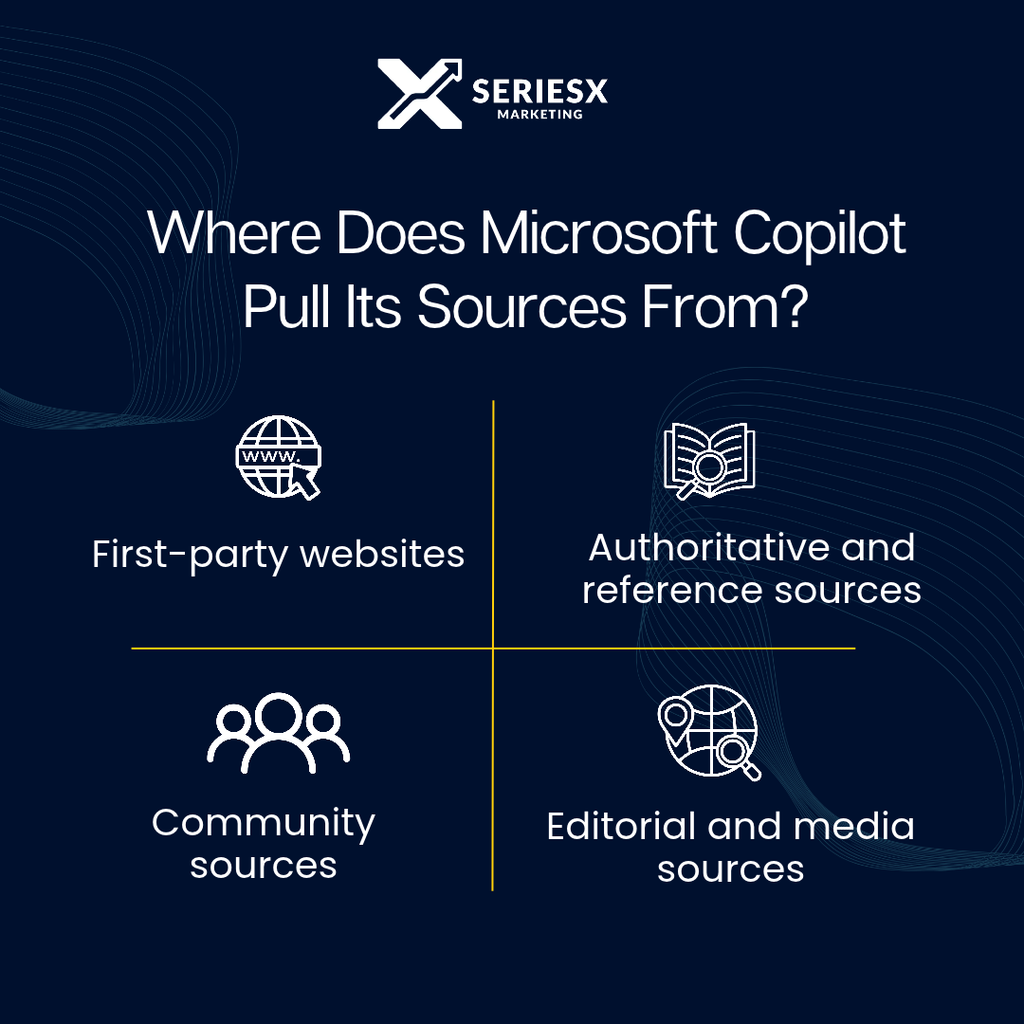
Copilot’s citations draw from four broad source types, and each plays a different role in how an answer gets generated:
- First-party websites: Official brand, company, and product pages that speak directly and authoritatively about themselves.
- Authoritative and reference sources: Platforms like Wikipedia and Wikidata, which Microsoft’s grounding systems can treat as high-trust anchors for entity information.
- Community sources: Reddit, Quora, and similar platforms, which surface real-world usage, opinion, and problem-solving language that formal content often doesn’t capture.
- Editorial and media sources: Publishers and journalistic outlets that provide independent verification and context around a topic.
Understanding these Bing Copilot sources matters because optimizing only your own site addresses one of four source types Copilot may be drawing from.
How Uneven Is Citation Visibility in Bing Copilot?
An analysis of 91 days of Copilot data found 19,717 citations across 86 pages, with 400+ unique grounding queries behind them. However, just one single page generated 69% of all citations in that set.
That’s a striking concentration, and it tells you something important about how to think about Bing optimization. Copilot citation visibility concentrates heavily on individual pages rather than spreading evenly across a domain. Having a well-optimized site overall isn’t enough on its own; a small number of specific pages tend to absorb the vast majority of citation activity, while the rest of the domain contributes very little.
| That changes how teams should prioritize what to fix first. Instead of spreading effort evenly across every page, it makes more sense to identify which pages are already earning citations (or have the strongest potential to) and double down there, rather than treating the whole domain as one undifferentiated asset. |
Does Structured Data Improve Citations in Bing AI Search?
Deepak Gupta’s GEO Measurement Study that tracked 50,431 AI citations across 240 pages, 200 prompts, and six AI engines found that deep “sameAs” schema markup produced a 34% overall citation-share lift across the engines tested. On Bing and Gemini specifically, that lift rose to 52%.
| This suggests that among whatever mechanisms drive citation share generally, entity markup does disproportionately more work on Bing than it does on other AI search engines in the same study. |
For a tactic that’s largely a one-time implementation cost, it makes schema one of the highest-leverage, lowest-effort levers available for this specific AI search surface, ahead of many content-heavy tactics for AEO and GEO.
How to Optimize for Bing AI Search (An Actionable Framework)
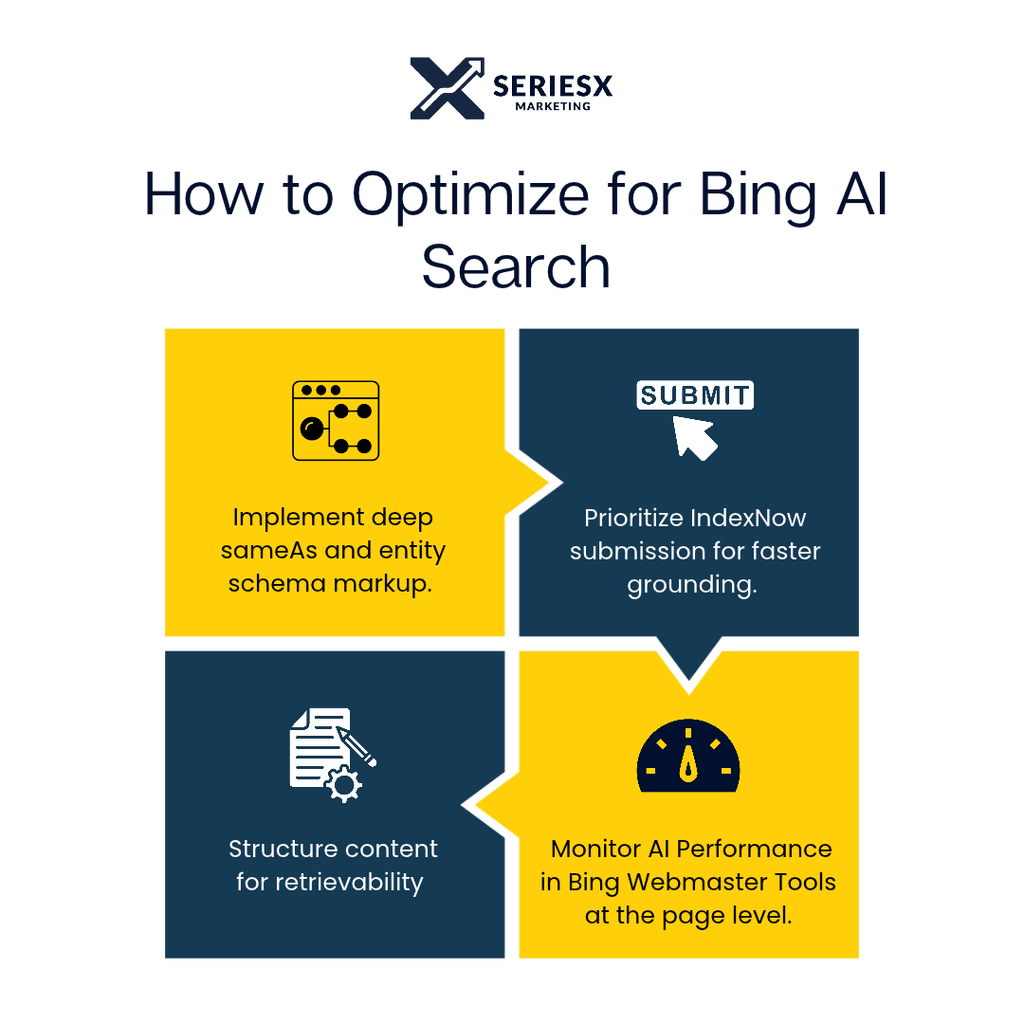
The data above points to four concrete, actionable levers rather than one-size-fits-all search advice.
Together, they form a practical Microsoft Copilot SEO framework — the answer to how to rank in Microsoft Copilot responses — built specifically around how Bing and Copilot ground their answers for AEO and GEO, and worth cross-checking against Microsoft’s own Bing SEO guidelines as they evolve.
1. Implement deep sameAs and entity schema markup.
Given the 52% Bing-specific lift tied to this tactic, dense, accurate sameAs linking to your official social profiles, Wikidata, Crunchbase, and other verifiable entity references should be treated as priority infrastructure.
2. Prioritize IndexNow submission for faster grounding.
IndexNow gives Bing a direct signal whenever content is published or updated, rather than waiting on a standard crawl cycle. Since freshness is one of the qualities Microsoft’s grounding systems weigh directly, keeping Bing’s index current on your latest content is a foundational step toward being retrievable in the first place. This is closely tied to Content Velocity and how quickly a team can publish and update content directly affects how quickly that content becomes eligible for grounding and citations.
3. Structure content for retrievability
This is where semantic SEO earns its keep: organizing content around clearly defined entities and their relationships to each other, rather than around keywords alone, gives grounding systems something they can parse for meaning instead of guessing at intent. In practice, this is content optimization for AI search applied at the sentence and entity level, not just the page level.
Content that states facts plainly, cites its own sources, stays current, and doesn’t contradict itself elsewhere on the site is simply easier for Copilot to lift with confidence.
4. Monitor AI Performance in Bing Webmaster Tools at the page level.
Because citation activity concentrates so heavily on individual pages, domain-level reporting won’t tell you much. Page-level data shows you exactly which pages Copilot is already treating as trustworthy evidence, so you can study what those pages have in common, like the structure, schema, freshness, or source attribution, and apply the same pattern to pages that aren’t yet being cited.
Bing AI Search Optimization Starts With Citations, Not Rankings
The patterns are hard to ignore: Bing’s AI layer can now be measured directly, citation visibility clusters a lot on individual pages rather than spreading evenly across the domain, and structured entity data moves the needle more on Bing than on most other search engines tested.
Teams that treat page-level citation data and schema markup as core optimization levers are the ones building durable visibility as Copilot’s role in search keeps growing.
For the broader shift this sits inside, see AI Search Optimization — or if you want a citation strategy built around Bing Search and ChatGPT data, explore our AI search/AEO services and contact us today.