

B2B buyers are conducting more independent research than ever, often defining their own purchase requirements before a sales rep enters the picture:
AI is answering questions that used to drive search traffic.
Zero-click results are becoming the norm.
And the tools marketers use to create, optimize, and distribute content have changed more in the past two years than in the previous decade.
For B2B marketing leaders trying to make informed decisions in this environment, the challenge isn’t a lack of data. It’s finding B2B content marketing statistics that are current, reliable, and organized in a way that’s actually useful.
Most stat roundups mix outdated figures with recent ones, cite sources without context, or bury the most relevant numbers inside categories that don’t match how marketers actually think about their work.
This resource is built differently.
The 75+ marketing statistics here are organized by theme so you can navigate directly to what matters for your current priorities — whether that’s making the case for content investment, understanding how AI search is changing discoverability, benchmarking your team’s adoption of AI tools, or rethinking your content formats and repurposing strategy.
The goal is simple: to give you a single, well-organized reference you can use to ground strategy discussions, support budget decisions, and stay current on a content marketing landscape that’s changing fast.
Key Takeaways
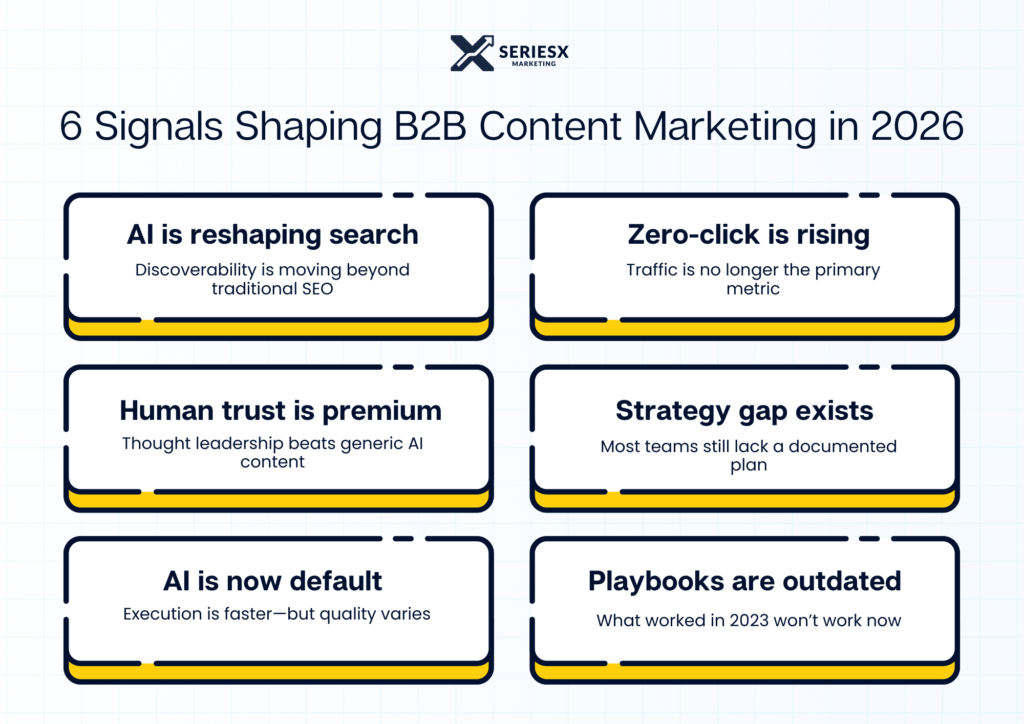
- Content marketing is now the primary growth channel for most B2B and SaaS companies — but buyer behavior, search, and content discovery have all changed significantly in the past 12–18 months.
- AI search is reshaping discoverability. Zero-click results, AI Overviews, and generative answers are reducing the traffic that traditional content strategies were built to capture.
- Trust and thought leadership from humans are more valuable than ever, precisely because AI has made it easy to flood the internet with generic content.
- Most B2B marketing teams are operating without a documented content strategy, even as buyer expectations rise and the competition for attention intensifies.
- AI adoption inside marketing teams has gone from optional to near-universal. The question is no longer whether to use it, but how to use it without sacrificing quality and credibility.
- The formats, update cadences, and optimization approaches that earn visibility in 2026 are measurably different from what worked two or three years ago.
B2B content marketing has fundamentally changed
Before diving into tactics, it helps to understand the baseline. How are B2B buyers actually behaving? How are marketing teams currently structured? And where are the biggest gaps between what teams are doing and what buyers expect?
The numbers paint a clear picture: content marketing is more central to B2B growth than ever, but most marketing teams are building on shaky foundations even as buyer expectations keep rising.
It’s a gap that explains why demand for external content marketing services has grown steadily and why the teams closing that gap fastest are the ones seeing the strongest returns.
Content marketing statistics for “B2B marketing strategy”
- 91% of B2B companies collect first-party data, but 31% admit it’s in the developing stage, while 19% admit it’s in the exploratory stage.
- Only 40% of B2B marketers have a formally documented content strategy; the majority work without one.
- As compared to traditional marketing, content marketing generated three times more leads per dollar and costs 62% less
- Over 70% of B2B marketers credit content marketing as a key driver of business success.
- 80% of B2B sales interactions now happen through digital channels, with buyers conducting most research independently.
- Nearly 83% of buyers define their own purchase requirements before ever speaking with a sales rep.
- Zero-click visibility & AI search are redefining digital discovery with 92% of marketers already using or incorporating LLM optimization for AI search engines.
- Partnering with content marketing agencies is a practical solution for B2B teams with 48% of companies outsourcing content marketing to external agencies or specialists.
- In a span of two years, the percentage of marketers not using AI for content creation has dropped from 65% to 5%.
Content marketing statistics for “thought leadership & trust”
Volume has never been the answer in B2B marketing, but the flood of AI-generated content has made that more true than ever. When anyone can publish anything in minutes, what actually creates competitive advantage in 2026?
Trust and credibility.
The statistics below show just how decisive those two factors have become at every stage of the B2B buying journey.
- 97% of B2B buyers say trust in the vendor is a decisive purchase factor making credibility more important than content volume.
- 73% of decision-makers place more weight on thought leadership than on standard marketing materials.
- 53% agree that high-quality thought leadership can compensate for limited brand recognition.
- 95% of decision-makers say strong thought leadership makes them more receptive to sales outreach.
- 86% of consumers say authenticity influences which brands they choose; 58% of Gen Z specifically seek brands with visible ethical practices.
Content marketing statistics “by format & performance”
Knowing what to say is only half the battle. How you package and present content determines whether it earns attention, drives engagement, and actually gets read. Not all formats perform equally, and the gap between high-performing and average content is wider than most marketers expect.
Here’s what the data shows about the formats and approaches consistently delivering the strongest results.
- Long-form content (3,000+ words) earns 3x more traffic than shorter pieces.
- Content that incorporates statistics achieves up to 40% higher visibility in AI-generated results.
- 44% of all LLM citations come from the first 30% of a piece — strong openings are critical.
- Listicles earn a 25% citation rate in AI results, compared to just 11% for how-to blogs and opinion pieces.
- Users spend an average of 4.5 minutes engaging with interactive content like quizzes, versus 1.3 minutes on static articles.
- Personalized content drives 39% higher click-through rates; segmented email campaigns generate 57% more revenue.
- With 22.26% share, blog posts are among the Top 5 highest ROI content formats.
- Nearly 80% of marketers currently use AI for content creation while 75% use it for media production.
- 77% of ChatGPT conversations fall into three categories: practical guidance (29%), information lookup (24%), and writing (24%).
Content marketing statistics for “AI search & discoverability”
If your content strategy was built around earning page-one Google rankings with SEO, the ground has shifted beneath it. AI Overviews, generative search, and zero-click results are fundamentally changing how B2B buyers find information, and how often they ever reach your website at all.
These numbers aren’t a reason to panic. But they are a reason to rethink how discoverability works in 2026.
- Google’s AI Overviews now reach over 1.5 billion users every month across 200+ countries.
- Generative AI adoption for content discovery grew 156% year over year.
- Click-through rates drop by up to 61% when an AI Overview appears in search results.
- Up to 60% of searches end with no click at all when an AI summary is present.
- Only 8% of users click traditional links once an AI-generated answer is shown.
- 58.5% of U.S. searches end without a click; this rises to 75% on mobile.
- 30% of U.S. desktop keywords now trigger AI Overviews — a record high as of late 2025.
- Queries of eight words or longer have a 57% chance of triggering an AI Overview.
- 92% of marketers are already optimizing content for AI search engines.
- AI platforms tend to cite content that is 25.7% fresher than what ranks in traditional search.
- Content updated within the past two months is 28% more likely to be cited by AI systems.
- Including schema markup improves AI citation likelihood by 30%.
- 40% of sources cited in AI Overviews come from pages ranking outside the traditional top 10.
- 86% of AI citations originate from brand-managed sources such as websites and listings.
- The GEO (generative engine optimization) market is projected to grow from $886 million in 2024 to $7.3 billion by 2031.
- Individual websites experience an average 34.5% CTR reduction when AI Overviews appear for their keywords.
- Zero-click search is higher on mobile, sitting at 75%.
- AI Search visitors are predicted to surpass traditional search visitors by 2028.
- Google accounts for over 93.9% of global mobile search market share.
Content marketing statistics for “AI citations & changing answer behavior”
Understanding that AI search exists is one thing. Understanding how it behaves, what it cites, how often those citations change, and where it sends users is another. The mechanics matter if you want your content to be part of the answer generated by LLMs, not just traditional search engines.
This section gets into the specifics of how AI platforms source, cite, and surface content.
- The average AI Mode answer contains 12.6 links; AI Overviews link to 13.3 sources on average.
- AI assistants hallucinate links nearly 3x more often than Google Search. ChatGPT is the biggest offender, with 2.38% of all cited URLs returning a 404 error.
- AI Overview content changes 70% of the time for the same query, and when a new answer is generated, 45.5% of citations are replaced with new ones.
- AI Overviews and AI Mode cite largely different sources and only 13.7% of citations overlap between the two Google AI features.
- 89% of citations differ depending on whether you ask ChatGPT or Perplexity for the same query.
- AI Mode’s most frequently cited websites are Wikipedia, YouTube, Google, and Reddit.
- Only 6–8% of AI Mode sessions result in a user visiting an external domain.
- The average AI Mode query is 7.22 words long.
Content marketing statistics for “AI in SEO” workflows
AI isn’t just changing how buyers find content. It’s changing how marketers build it. Adoption has moved from early experiment to standard practice at a speed that caught most companies off guard, and the teams that are figuring it out are seeing measurable results.
Here’s where the industry actually stands on AI integration right now.
- 87% of marketers use AI to support content creation.
- 75% use AI to reduce time spent on manual tasks such as keyword research.
- 68% of businesses report improved marketing ROI after adopting AI-driven workflows.
- 67% of businesses say AI has improved their overall content quality.
- Businesses using AI for SEO see up to 45% more organic traffic and 38% higher conversion rates.
- 75% of Google searches will feature AI search and the majority of global daily queries will be handled by AI by 2028-2030.
- With over 74% of new content published online being AI-generated, the standard for what constitutes quality content creation has shifted.
- 13% of top-performing Google content is AI-generated, up from just 2.3% before GPT-2.
- AI Overviews are driving over 10% more Google queries for the types of searches that show them, indicating users actively seek out these AI-powered results.
- 25.7% of marketers plan to develop content specifically optimized for AI citation.
Content marketing statistics for “repurposing & lifecycle marketing”
More content isn’t always the answer. For many B2B teams, the highest-ROI move isn’t publishing something new, it’s extending the reach and usefulness of what already exists.
The statistics here make a compelling case for shifting some of your production budget toward content optimization and repurposing.
- 94% of content marketers repurpose their content for different channels and mediums.
- Repurposing existing content improves ROI by an average of 32%.
- Lifecycle optimization by extending the usefulness of existing content increases organic traffic by 28%.
- 46% marketers believe repurposed content performs better than original content.
- When compared to starting from scratch, repurposed content saves 60-80% of content creation time
- 38% of marketers rank updating and repurposing existing content among their top success factors.
- ROI is measured effectively by only 29% of marketers, revealing a major disconnect between performance and tracking systems.
- Producing content weekly results in a 3.5x increase in conversions as compared to monthly publishing.
- Over 80% of marketers believe quality over quantity is the right approach, even if it means publishing less frequently.
Content marketing statistics by “market & platform”
Zooming out from individual tactics, it’s worth understanding the larger forces reshaping the market. AI’s influence on how buyers find information, how companies allocate budgets, and where digital visibility is heading will shape B2B content strategy for years to come.
- The generative AI market is projected to reach $1.26 trillion by 2034, growing at a 29.3% CAGR.
- PwC projects AI will boost local GDP by up to 26% by 2030.
- Google still holds roughly 90% of the global search market, processing over 15 billion queries per day.
- Buyers increasingly get answers from AI-generated summaries, featured snippets, and conversational search interfaces, decreasing search traffic by 30%.
- 42% of marketers are actively growing their LinkedIn presence; four in five LinkedIn members influence or make business decisions.
- Software stocks fell more than 20% in 2026 as companies rationalized their SaaS stacks — the average number of applications dropped from 112 to 106.
- Social media is the most frequently used channel for 75% of B2B marketers.
How to Stay Competitive in B2B Content Marketing
The B2B content marketing statistics in this article point to real pressures of shrinking organic traffic, rising buyer expectations, and a content landscape being reshaped by AI at speed. But they also point clearly to what separates teams that are pulling ahead from those that are falling behind.
The content marketing trends shaping 2026, such as AI-driven discovery, zero-click search, and the growing premium on trust, aren’t emerging signals anymore; they’re the new baseline every B2B team is operating against.
- Build your strategy on paper, not instinct. Only 40% of B2B marketing teams have a documented content strategy. That gap is a competitive opportunity. Teams with a clear, written strategy make faster decisions, waste less budget, and produce content with more consistent direction.
- Optimize for AI discoverability, not just traditional search. AI Overviews now reach over 1.5 billion users monthly, and 40% of AI citations come from pages outside the traditional top 10. Structure your content with strong openings, clear formatting, schema markup, and regular updates – signals AI platforms reward.
- Invest in thought leadership over volume. 97% of B2B buyers say trust is a decisive purchase factor. In a market flooded with AI-generated content, genuine expertise and a distinct point of view are increasingly rare, and increasingly valuable. Publish less if you need to, but make what you publish worth citing.
- Refresh before you create. Content updated within the past two months is 28% more likely to be cited by AI systems. Repurposing existing content improves ROI by an average of 32%. A regular refresh cycle on your best-performing evergreen content will consistently outperform a strategy built purely on net-new production.
- Match your formats to how buyers actually discover content. Long-form content earns 3x more traffic. Listicles are cited at more than double the rate of standard blog posts in AI results. Interactive content generates 2–3x more engagement. Format decisions aren’t aesthetic, they’re strategic.
- Make data-driven decisions a habit, not a quarterly event. The benchmarks that guided content strategy 18 months ago are already outdated in several key areas. Teams that regularly pressure-test their assumptions against current data will adapt faster and waste less time pursuing approaches that no longer perform.
Final Thoughts: What These Statistics Mean for Your Content Strategy
The data makes one thing clear: the rules of content marketing haven’t disappeared, they’ve been rewritten. Buyers still need trust before they buy and decision-makers still respond to genuine expertise. Well-structured, regularly updated, insight-driven B2B content still earns visibility across both search engines and AI platforms.
The teams that will win aren’t the ones producing the most content. They’re the ones producing the right content, built for how buyers actually discover and evaluate it today.
At SeriesX Marketing, we help B2B teams build content strategies that are grounded in data, built for AI-era discoverability, and designed to earn the kind of trust that actually moves deals forward. If the statistics above reflect challenges you’re navigating, we’d love to talk about how to turn them into a competitive advantage.
Ready to scale your content engine without new hires?
We onboard a limited number of clients each month.
Sources:
- Content Marketing Institute
- Averi.ai
- Gartner
- Backlinko
- 6sense
- Forbes
- Hubspot
- Ahrefs
- Typeface
- Medium
- Semrush
- PredictableProfits
- PWC
- Ascend2
- Learningnews
- Edelman
- Nielseniq
- Searchengineland
- Marketingltb
- Libril
- Ranktracker
- TheVerge
- Superlines
- Dataslayer
- Elementor
- Sparktoro
- Seo.com