

Most SaaS marketing teams are producing more content than ever but are seeing less return on each piece than they’d like.
The blog gets published, the webinar wraps up, the case study goes live, and then everything quietly collects digital dust in a page somewhere while the team scrambles to create the next thing.
That’s the content trap. And in 2026, it’s more costly than ever to fall into it.
The obvious answer of creating more content isn’t the correct answer. It’s to make what you’ve already created go further.
Content repurposing, the practice of taking an existing asset and reshaping it for different formats, channels, and audiences, is how the most efficient SaaS marketing teams are stretching their budgets, reaching new buyers, and staying consistent across every platform without burning out.
This isn’t about recycling mediocre content. It’s about recognizing that your best ideas deserve more than one shot at reaching the right person. With the right repurposing strategy, a webinar that 200 people attended live could reach 20,000 across LinkedIn, email, podcast feeds, and your sales team’s outreach sequences.
In 2026, the SaaS companies winning in content aren’t necessarily the ones publishing the most. They’re the ones distributing what they have the most intelligently.
By the end of this guide, you’ll have 27 concrete tactics for fueling lead generation, enabling your sales team, retaining customers, and building brand authority without starting from scratch every single time.
Key Takeaways:
- Most SaaS marketing teams are producing more content than ever but seeing less return indicating that the problem isn’t output, it’s distribution.
- Content repurposing means taking one existing asset and reshaping it for different formats, channels, and audiences.
- A single webinar, blog post, or case study can fuel LinkedIn posts, email sequences, podcast episodes, sales one-pagers, and more.
- The SaaS companies winning in content in 2026 aren’t publishing the most but distributing what they have most intelligently.
- Sales teams are often underserved by marketing content because assets are never adapted into formats that fit a sales conversation — repurposing fixes this.
- Repurposing also serves existing customers, not just prospects by reducing churn through consistent, well-timed content touchpoints.
- The best repurposing strategies start at the briefing stage, not after an asset is already live.
What is Content Repurposing and Why is it a Smart Tactic?
Content repurposing means taking one asset and adapting it into different formats for different channels and audiences. In 2026, with AI flooding every channel with content at volume, raw output no longer differentiates you. You need to have a robust content repurposing strategy that increases you presence across the channels your buyers actually use.
Maximize your Content ROI and Combat Budget Pressures
Every asset needs to justify its cost beyond the first week of publication. A research report that took three weeks to produce shouldn’t live and die as a single PDF.
Once you plan for repurposing from the briefing stage, the return on every original asset keeps compounding long after it’s published.
Expand Reach Across Key SaaS Content Distribution Channels
Your buyers are spread across LinkedIn, podcasts, developer communities, and organic search. If your content only exists in one format, you’re invisible to most of them. A single webinar insight can become a LinkedIn post, a podcast clip, a sales one-pager, and a blog post without creating anything new.
Empower Your Sales Team with Effective Sales Enablement Content
Most marketing libraries go unused by sales because the content was never adapted into formats that fit a sales conversation. Content recycling gives a new life to these pieces. A comparison blog becomes a battlecard, a testimonial video becomes a 20-second outreach clip. The teams closing the most deals are the ones whose reps have the right content at the right moment.
Deepen Relationships Through Customer Marketing
Most SaaS content strategies are weighted toward acquisition and leave customers under-served after they sign. Help docs become embedded tutorials, product updates become in-app notifications, and benchmark reports become newsletter features. Customers who feel consistently informed are measurably less likely to churn.
27 Creative Ways to Repurpose Your SaaS Content in 2026
Before diving in, it’s worth noting that the best ideas for repurposing almost always start with written content. Blogs, guides, and whitepapers form the backbone of most SaaS content libraries and offer the richest raw material to work with.
Building a repeatable content repurposing workflow around your written assets is the fastest way to see compounding returns, because the volume of written content most teams already have means you can start repurposing content today without commissioning a single new piece.
Section 1: Repurposing Blogs & Written Content Assets
1. Blog Post → LinkedIn Article / Newsletter: Take your blog’s top three takeaways and turn them into a punchy LinkedIn post.
Write the insight natively and drop the link in the comments, the way SeriesX Marketing does with their guides.

| Blog Post: The Continuous Content Engine |
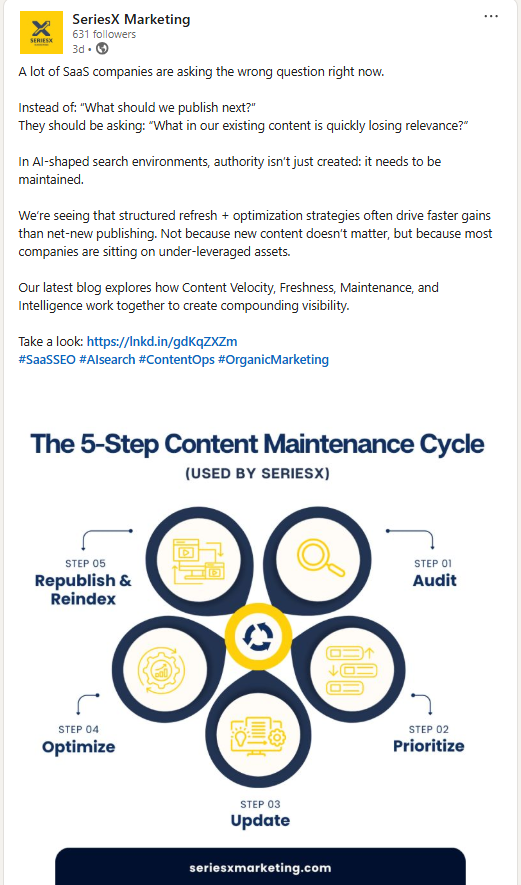
LinkedIn Post
2. Blog Post → Threads on X: A great repurposing example is breaking a blog into a multi-post thread, unpacking one key insight per post.
In 2026, you can test Bluesky alongside X, especially if your audience skews toward product and developer communities.
3. Series of Blog Posts → Pillar Page / Ultimate Guide / eBook: Bundle related blogs into a comprehensive pillar page with original commentary and updated data.
Zapier’s integration guides are a masterclass in this, consistently dominating high-intent search queries.
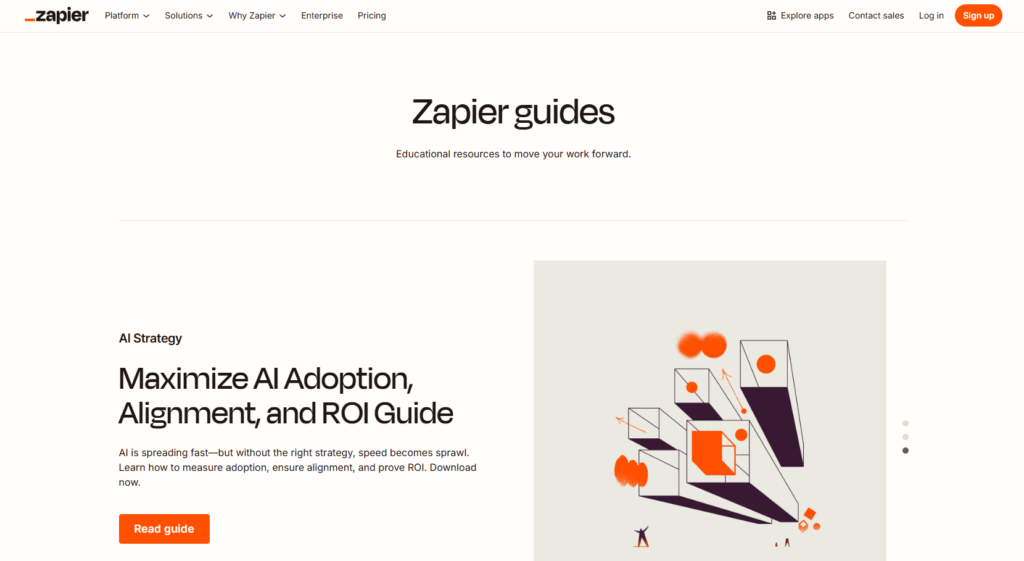
Source: Zapier
4. Blog Post → Email Nurture Sequence Snippets: Break up a blog into one focused idea per nurture email, giving your content multiple inbox touchpoints without writing anything new.
5. Blog Post → Short-Form Video Script: Rewrite your blog’s core argument as a 60–90 second script for LinkedIn or YouTube Shorts.
Webflow regularly turns their written content into short videos that reach audiences who’d never read the full article.

Source: Webflow’s University Full of Learning Content
6. Whitepaper / eBook → Series of Blog Posts: Break a data-rich report into individual MOFU blog posts per chapter.
Klaviyo does this with their e-commerce research, using each post to drive search traffic back toward the full gated report.

Source: Klaviyo referencing its own research in separate blogs.
7. Blog / Whitepaper / eBook → Key Stats for Infographics or Social Media: Pull three to five striking statistics and pair each with a short interpretive caption explaining why the number matters.
Section 2: Repurposing Video and Audio Content
8. Webinar Recording → Short Social Video Clips: Another good example of repurposing is to clip webinar highlights into 30–60 second vertical videos with burnt-in captions.
Salesloft does this with their demand generation webinars, reaching audiences who’ll never watch the full recording.

Source: Salesloft has a series of YouTube Shorts for audiences that won’t watch full webinars.
9. Webinar Recording → Blog Post Summary and Key Takeaways: Turn your webinar into a timestamped recap blog that lets readers jump to the sections most relevant to them, while also capturing long-tail search traffic for months after the live event.
10. Webinar Recording → Audio Podcast Episode: Extract and clean up the audio from your webinar and publish it as a podcast episode.
Reforge extends the shelf life of their member sessions this way, reaching listeners who prefer consuming content on the go.

Source: Reforge turns its webinar events into full podcasts.
11. Product Demo Video → GIF Feature Highlights: Turn specific product interactions into looping GIFs for help docs, release notes, or social posts.
Intercom does this across its homepage to showcase features of their AI helpdesk.

Source: Intercom
12. Product Walkthrough Video → Step-by-Step Onboarding Email Series: Break a product demo into a sequence of onboarding emails, one workflow per email, segmented by user role or use case for meaningfully better activation rates.
13. Video Interview → Quote Graphics for Social Media: Social media reposting by pulling one strong quote from an interview, overlaying it on brand visuals, and posting it on LinkedIn.
14. Podcast Episode → Blog Post with Editorial Commentary: Transcribe your episode, reshape it into a readable article with subheadings, and add commentary that expands on points that benefit from written elaboration.
15. Podcast Episode → Audiograms for Social Sharing: Turn 30–60 second audio highlights into captioned audiogram videos for platforms where audio doesn’t play natively.
Section 3: Repurposing for Sales Enablement & Lead Generation
16. Blog Post / Guide → Sales One-Pager / Cheat Sheet: Distill a guide’s core insights into a single-page, problem-focused asset your SDRs can drop into follow-up emails.
17. Webinar Slides → LinkedIn Document Post: Polish your webinar deck and upload it as a LinkedIn Document Post.
Gong does this regularly with their research decks, generating thousands of impressions without any paid amplification.

Source: Gong regularly turn their webinars into LinkedIn research decks.
18. Customer Testimonial Video → Clips for Sales Outreach Emails: Clip a testimonial into a 15–20 second persona-specific soundbite for outreach emails.
19. Customer Testimonial Video → Clips for Social Media: Post short, unscripted customer “before and after” clips on LinkedIn and YouTube.
Notion does this across verticals, letting different clips resonate with different segments of their audience simultaneously.

Source: Notion posts videos of different customers using Notion
20. eBook / Guide → Interactive Quiz or Assessment (Lead Magnet): Transform the diagnostic questions in a guide into a self-assessment lead magnet.
21. Technical Documentation → User-Friendly FAQ Section: Rewrite dense docs into plain-language FAQs for the non-technical buyers.
Zoho CRM has a dedicated page for FAQs of its different processes making it easier for users to answer queries quickly.

Source: Zoho CRM FAQ Page
22. Competitor Comparison Page → Sales Battlecard: Condense your comparison page’s strongest proof points into a rep-friendly battlecard for your sales team.
Section 4: Repurposing for Customer Marketing & Community
23. Product Update Blog → In-App Notification Summary: Turn release notes into a concise in-app prompt that surfaces at the moment the user is already in the product.
Spotify masters this with in-app notifications that feel seamless and doesn’t obstruct user experience.

Source: Google
24. Help Docs → Short “How-To” Video Tutorials: Embed a short screen-recorded walkthrough directly inside your help article.
25. User Success Stories → Community Spotlight Posts: Celebrate customer wins on LinkedIn or in your Slack community.
Notion regularly showcases how their clients are using Notion’s features to improve their business.

Source: Notion LinkedIn Page
26. Annual Data Report → Customer Newsletter Highlights: Pull three to five findings from your annual report into a visual newsletter section, framing each stat around what it means for your reader specifically.
27. Product Changelog → “Built for You” Monthly Roundup Email: Compile a month of product updates into one curated email rather than peppering customers with individual release notes.
Formsort does this with a magazine-style format that frames every update around user benefit, not technical detail.

Source: Emailoctopus
Content Distribution Strategy: Amplifying Your Repurposed Content
Repurposing content is only half the job. The other half is making sure it actually reaches the people it was created for. Here are the five distribution strategies that are driving the strongest results for SaaS teams in 2026.
Leveraging LinkedIn for Maximum B2B Impact
Post insights natively, drop links in the comments, and lean on document posts, carousels, and short vertical videos to maximize organic reach without spending a dollar.
Nurturing Leads with Repurposed Assets via Email Marketing
Feed your nurture sequences with repurposed content such as blog snippets, embedded video clips, and gated asset links to keep prospects engaged across every funnel stage without writing anything new.
Equipping Sales Teams via CRM & Sales Enablement Platforms
Upload battlecards, one-pagers, and testimonial clips into your CRM or sales enablement platform tagged by persona, use case, and deal stage. This allows the right asset to surface at the right moment without the rep having to hunt for it.
Targeted Paid Promotion Strategies
Amplify your highest-value assets with LinkedIn Document Ads or Lead Gen Forms, and retarget audiences who’ve already engaged with your organic content to serve them the next logical piece.
Engaging Niche Communities Carefully and Authentically
Slack groups, LinkedIn communities, Discord servers, and Reddit threads reward genuine value and punish self-promotion. Only share repurposed content when it directly and authentically answers a question someone has already raised.
Budgeting for SaaS Content Repurposing: Key Considerations
A repurposing strategy is only sustainable if it’s resourced realistically. Here’s what to think through before you scale.
Allocating Time: Estimating Effort for Common Repurposing Tasks
Build repurposing into the briefing stage, not after the asset is live, because that’s where the real time savings compound, regardless of how many AI tools you’re using.
Choosing the Right Content Repurposing Tools Wisely
Keep your stack lean by choosing the right tools:
- Design (Canva, Adobe Express)
- Video (Descript, CapCut for Business)
- AI writing (Claude, Jasper)
- Scheduling (Buffer, Taplio)
- Interactive content (Outgrow, Typeform)
These tools cover everything most SaaS marketing teams need.
Personnel Planning: In-House vs. Agency vs. Freelancer
Keep core content creation in-house or work with specialized agencies who understand your domain and audience, use freelancers for format-specific work like video editing or infographic design, and bring in a content repurposing agency like SeriesX Marketing when you need a repurposing system built and run at scale.
Measuring Success: KPIs for Your Repurposing Efforts
Track gated downloads and MQL conversion for lead gen assets, content usage and deal velocity for sales enablement, and engagement rate benchmarked against original content for reach. Repurposed content should be measured as rigorously as anything else you produce.
Make Your Content Work Harder in 2026
Content repurposing isn’t a hack, it’s a strategic move to maximize your content marketing ROI.
By taking your existing valuable assets and transforming them into different formats for various channels and audiences, you can expand your reach, fuel your lead generation, empower your sales team, and deepen customer relationships, without constantly reinventing the wheel.
Begin by revisiting your existing content library this week. There’s a good chance you’re sitting on valuable assets that can be transformed into fresh, high-impact content. Choose just one repurposing tactic from the list above and put it into action—you might be surprised by how far a single piece can go.
Overwhelmed and need a hand building a well-oiled SaaS content repurposing engine? The team at SeriesX Marketing is here to help you optimize your content strategy and get the most out of every piece you create. Let’s chat.
Ready to scale your content engine without new hires?
We onboard a limited number of clients each month.