

Picture this: a marketing head or CFO at a B2B tech company is reviewing their content-related spend.
On one side of the spreadsheet, a freelancer is at $65/hour.
On the other hand, a content marketing agency retainer is $5,500/month.
And somewhere in the middle, the option of hiring an in-house content marketer at an average of $65,000 a year.
The math looks obvious: go with the freelancer, spend less, and get more flexibility, right?
Except that’s not how it plays out long term for compounding growth in marketing.
Three months later, the head of marketing is spending 10 hours a week managing briefs, chasing deadlines, and rewriting drafts that missed the mark.
The blog sounds different from every other post.
Two of the three freelancers they relied on have gone dark.
And the organic traction they expected? Nowhere to be seen.
In B2B content, visible costs are rarely the real costs. The comparison between agency, freelancer, and in-house hiring models only makes sense when you look at the full ROI picture: not just the invoice, but the management time, consistency, strategic value, and compounding returns (or losses) each model produces over 12–18 months.
This article breaks down all three models as honestly as we can. That means acknowledging where freelancers and in-house hires genuinely win, not just where they fall short.
A quick comparison, before we dive deeper:
| Freelancer | In-House Hire | Content Marketing Agency | |
| Best for | One-offs, early stage | High-volume, core function | Scaling B2B content |
| Biggest risk | Inconsistency at scale | Tenure and scope creep | Retainer commitment |
| ROI over 12 months | Plateaus | Depends on hire | Compounds |
The goal isn’t to push you toward any one answer, it’s to help you match the right model to your actual stage and situation.

Why the Agency vs Freelancer Decision Is Really an ROI Question?
The real question to ask is not “which option is cheapest?” It’s “which option produces the most content-driven revenue per dollar spent.
The B2B buying cycle is long, research-heavy, and trust-dependent.
A CFO or procurement head evaluating a $100,000 software contract isn’t making that decision after checking a review or reading just one blog post on the website.
They’re evaluating you across every touchpoint over weeks or months. Which means every inconsistent article, every generic piece of thought leadership, and every social media post that fails to talk their language or address their real objections is both trust lost and money wasted.
This is where the economics of cheap content become particularly punishing in B2B marketing:
SEO compounds in both directions
Poor-quality or thin content doesn’t just fail to rank; it also dilutes your domain authority over time. The damage accumulates over 6–12 months, often long after the decision to use cheaper content creation services has been made.
By the time you notice organic traffic plateauing or declining, it’s too late to bounce back.
Brand inconsistency signals operational immaturity
In B2B, buyers making high-stakes purchasing decisions are reading your content as a proxy for how you run your business. A blog that sounds like three different companies, which is what you get when three different freelancers have written 40 posts, signals exactly the kind of disorganization enterprise buyers are trying to avoid in a vendor and erodes their trust.
Freelancers rarely engage with your sales reality
The typical freelance vs agency content quality gap isn’t about writing ability; it’s about context and multi-domain experience.
A freelancer working from a brief doesn’t sit in on sales calls, doesn’t know which objections keep coming up in demos, doesn’t talk to leadership regularly, and doesn’t understand which pipeline stage a piece of content is meant to serve and how it will move marketing KPIs.
The result is content that reads well but doesn’t move the needle, and content that doesn’t impact your business in some way has a negative ROI regardless of how cheap it was to produce.
Every month of inconsistent output is a month you cannot recover
SEO authority, audience trust, and thought leadership positioning are all built through sustained, on-brand, consistent publishing of content that serves a purpose.
A month lost to a freelancer dropping off, a new hire taking time to get up to speed, or a gap in the content calendar is a month that can’t be reclaimed to support your growth goals.
What Are the Hidden Costs of Managing Freelancers for B2B Content?
To be clear: freelancers aren’t the wrong answer in every situation.
For early-stage companies testing content formats, validating topics, or running one-off campaigns, outsourcing content creation to a skilled freelancer is often the most sensible choice. The economics work when the scope is narrow and the management overhead is low.
But when companies try to scale content production through freelancers, particularly in B2B, the model starts to break. Here’s why:
The freelance model looks clean on paper: you pay per word or piece, there’s no overhead, and you can scale up or down as needed.
Easy.
In practice though, the management burden is substantial and almost always lands on someone whose time is worth far more than the cost savings.
There is no institutional memory.
Every new piece requires re-briefing. The freelancer you used three months ago doesn’t remember your ICP, know your updates to the product positioning, or the particular angle you’re trying to own.
You start from scratch every time.
Vague briefs increase revision cycles, driving up costs.
The cost of a $300 blog piece doesn’t end at $300. When the first draft misses the positioning, or uses the wrong tone, or ignores the actual buyer pain point, you’re pulled into multiple revision rounds.
The time spent giving feedback, rewriting, and re-editing is a real cost to your business and it’s one that rarely gets counted in the agency vs freelancer comparison.
Reliability is structurally fragile.
Freelancers take on other clients, have capacity fluctuations, get sick, and burn out. A single missed deadline can derail the content calendar and stall your growth priorities.
If the freelancer was covering a pillar page launch or a campaign-critical asset, the downstream consequences ripple outward.
Multiple freelancers produce multiple voices.
Using several freelance writers across a blog produces multiple tones, quality standards, and interpretations of your brand.
Maintaining any semblance of consistency then requires an internal editor — which is another cost that never appeared in the original calculation.
The management burden defaults to your highest-leverage people.
Someone has to own this content workflow. In most startups and scale-ups, that’s the founder, the head of marketing, or the content lead. High-leverage people doing low-leverage coordination work is one of the most expensive inefficiencies for a growing B2B company.
Freelancers are the right call when:
- You’re validating content formats or topics before committing to a full programme
- You need surge capacity for a one-off campaign without a long-term commitment
- The piece is highly specialized and needs a technical deep-dive or SME interview, along with a tight, well-defined brief
The more volume and strategic complexity grows, the more the agency vs freelancer calculus shifts.
When you’re honestly evaluating freelance vs agency content quality, this is the dimension that matters most, not the per-piece price, but the total system cost of making freelancers work.
Is Hiring an In-House Content Marketer Worth It?
Hiring a full-time content person feels like the responsible, scalable move.
You get someone embedded in the company, building context over time. And in some cases, it genuinely is the right call — particularly for companies with large enough content programmes to justify a dedicated team, or where the content function is core enough to the business model that it warrants internal ownership.
But the economics and the scope expectations are often misunderstood.
The all-in cost is substantially higher than the salary.
According to the U.S. Bureau of Labor Statistics, the total cost of employment, including benefits, payroll taxes, tools, and onboarding typically adds 25–30% on top of base salary.
A $70,000 content hire often costs $90,000–$100,000 or more in total spend.
| Read more: 75+ Content Marketing Statistics |
Full productivity doesn’t arrive on day one.
A new content marketer hire needs 3–6 months to genuinely understand the product/service, the ICP, the competitive landscape, and the brand voice.
During that window, they’re producing content, but it’s not fully developed and not what most companies plan for when they think about the new hire’s time to impact.
One person cannot own an entire content system.
Content strategy, SEO & AEO, content writing, proof reading and editing, email & social media distribution, campaign assets, sales enablement, demand gen — these are not one person’s job. They’re a marketing team’s job.
The content hire either becomes a bottleneck trying to do everything, or they require additional support hires to function. Neither outcome matches the original expectation.
Tenure is a real risk.
The average content marketer tenure at a company is 18–24 months. When someone leaves, which they often do, they take the institutional knowledge, the brand voice they’ve built, the relationships with subject matter experts and agencies, and the undocumented processes with them.
You’re not back to zero, but you’re further back than you think.
Hiring one strong writer is not the same as building a content engine.
This is the most common mistake we see.
A content system is a set of repeatable processes – including ideation, briefing, production, editing, publishing, and measurement – that delivers consistent output regardless of who’s doing the work.
A single hire delivers content. A content marketing agency delivers the infrastructure to go with it.
In-house hiring makes sense when:
- Content is a core competency, not a support function
- Volume is high enough to keep a small team fully utilized
- The programme has matured and needs internal ownership of strategy, with an agency executing alongside
The strongest content programmes often combine both.
What Does a B2B Content Marketing Agency Actually Deliver?
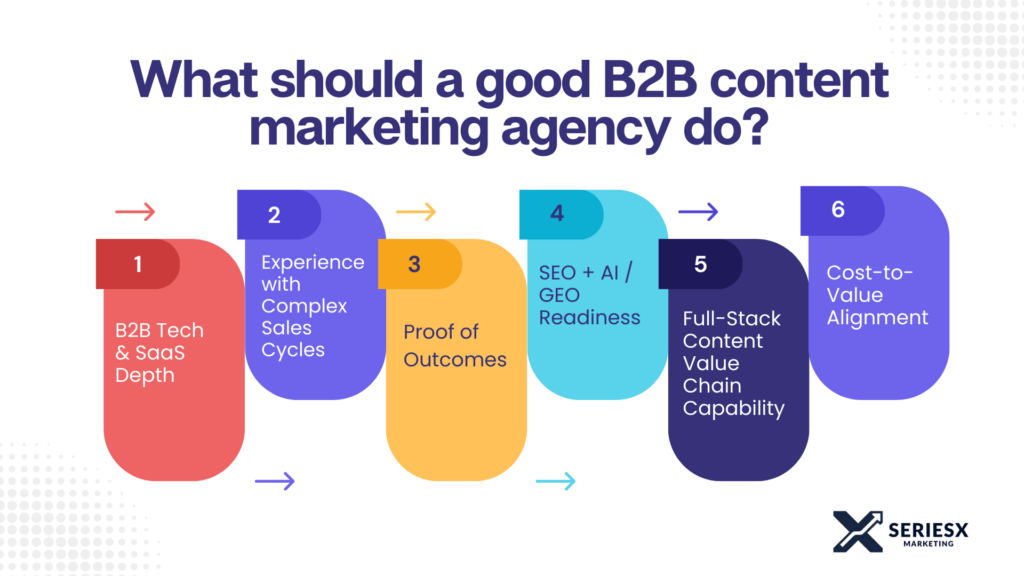
The case for working with a B2B content marketing agency isn’t just about outsourcing content writing. At its best, the agency vs freelancer comparison misses what an agency actually is: a content production system, tight operational processes, project management, quality control, and accountability embedded from the start.
Here’s what that looks like in practice:
A repeatable production system, not just deliverables
The output isn’t just content, it’s a functioning pipeline with content calendars, briefs, SME interviews, editorial review, follow-ups, publishing schedules, feedback loops, and regular reporting.
You plug into an existing infrastructure, and don’t have to build it from scratch.
Bench depth eliminates single points of failure
When your in-house writer or content marketer is sick or on leave, the content calendar stops. When an agency’s writer is unavailable, the agency absorbs that internally to ensure no deadlines slip and no calendars derail.
Strategy is embedded, not bolted on
A well-run content marketing agency doesn’t just execute what you ask for; they push back when a better approach exists.
They identify gaps, connect content to pipeline goals, and flag when you’re investing in the wrong areas. That’s the difference between content creation services and content strategy services.
Cross-functional capability at a consistent voice
SEO, thought leadership, demand generation, sales enablement, and brand content – an agency with B2B marketing experience handles all of these dependencies with a coherent brand voice in the delivered content, rather than fragmenting across specialists with no relation between the disciplines.
Built-in accountability
Deliverables, turnaround times, brainstorming sessions, and regular reporting create a structure that freelancers can rarely provide, while in-house content hires often lack the resources or infrastructure to produce.
This is especially important for content marketing teams that need to demonstrate business impact to leadership.
Faster time-to-quality
Because agency onboarding processes, editorial standards, and templates already exist, the ramp time to good output is significantly shorter than with a new hire.
Some of SeriesX’s engagements have produced publication-ready content from the first submission, with minimal revision cycles, because the editorial infrastructure is already in place.
Cross-client and cross-industry knowledge
A content marketing agency working across multiple B2B clients brings pattern recognition that no single in-house hire can replicate: what content formats are performing, what content marketing trends are shifting, where ICP audiences are and aren’t engaging anymore, and what competitive approaches are emerging.
The AI-Augmented Content Agency: A Fourth Model Worth Knowing
There’s a model that rarely gets acknowledged in the agency vs freelancer conversation: the AI-augmented content agency.
This is where content agencies use AI agents and workflows to accelerate the operational side of content such research, briefing, competitive analysis, and content refresh planning while keeping human writers and strategists in control of the final output. The result is faster turnaround, lower cost per unit, and no compromise on quality.
This matters because one of the most common objections to agency retainers is that they feel expensive relative to the deliverable count. AI-augmented ops change that equation. When research and briefing are accelerated by AI, senior marketers and strategists spend more time on high-leverage work like positioning, structure, and insight and less time on the grind.
At SeriesX, this is built into the delivery model. Our internal tools like the Blog Brief Generator and Content Refresh Agent handle the time-intensive groundwork of sourcing data points, mapping existing content gaps, and structuring briefs so writers go into every draft with a tighter, more strategic foundation. Human expertise stays at the centre. The AI removes the inefficiency around it.
For companies weighing the agency vs freelancer question on pure economics, the AI-augmented model narrows the gap considerably. You get the system, the strategy, and the consistency — at a per-unit cost that’s increasingly competitive with managed freelancer models that still carry all the coordination overhead.
The Compounding Returns of an Agency Engagement
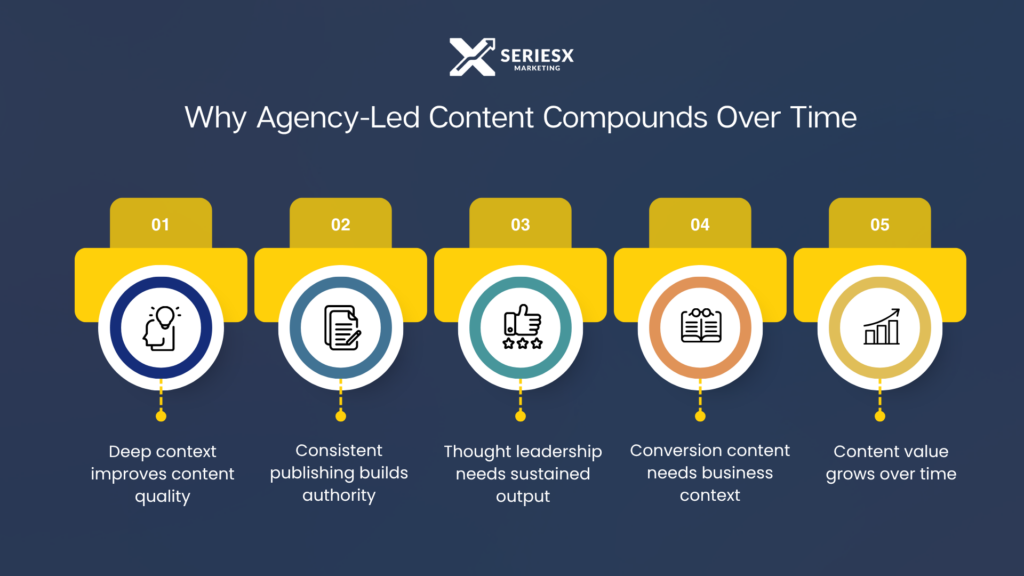
The core economic argument for the agency model is this: it produces increasing returns over time, while the freelancer model plateaus or deteriorates, and the in-house model is subject to tenure and attrition risk.
Deep context compounds into better outcomes
A content marketing agency that has worked with a B2B tech company for 6+ months carries accumulated knowledge of the ICP, the product, the objections, the competitive landscape, and the sales cycle.
That knowledge gets baked into every subsequent piece of content, making it sharper, more targeted, and more effective than anything a new freelancer or fresh hire could produce in their first few months on the job.
Sustained publishing builds domain authority
Organic pipeline from content doesn’t come from a handful of blog posts; it comes from consistent, high-quality publishing over quarters.
That kind of publishing consistency is what the freelancer model structurally struggles to sustain. The content marketing agency model is built for it.
Regular thought leadership requires volume and clear positioning
One excellent white paper doesn’t build a thought leadership position.
A quarterly publishing cadence of insights, points of view, and expert commentary sustained over 12–18 months does. That requires a content strategy maintained across time, not a series of disconnected briefs.
Content that converts needs institutional knowledge
Case studies that address real objections, nurture sequences that map to pipeline stages, and objection-handling content that reflects actual sales conversations only get built when a content partner understands the business deeply enough to create them.
Agency retainer costs are fixed while content value grows
A freelancer’s costs stay variable and unpredictable. An in-house team’s payroll costs increase with headcount, promotions, and hiring inflation.
Except for general inflation, an agency retainer stays fixed for the duration of the contract, while the organic search value, audience trust, and pipeline contribution of the content library continue to grow.
The ROI on a fixed investment that appreciates over time is a fundamentally different economic proposition than variable spend that produces inconsistent output. This is the core case for content outsourcing at scale — not cost reduction, but compounding value on a fixed investment.
Agency vs Freelancer vs In-House — A Realistic Cost Comparison
The table below maps the three models across the dimensions that matter most at scale. Output levels of 4, 8, and 16 pieces per month reflect where most B2B tech companies sit at Series A, Series B and beyond, respectively.
| Freelancer | In-House Hire | Content Marketing Agency | |
| Monthly cost | Low upfront, scales unpredictably | Fixed, but high all-in | Higher, but predictable costs and compounding returns |
| Management time required | High | Medium | Low |
| Strategy included | No | Partial | Yes |
| Consistency | Low | Medium | High |
| Scalability | Difficult | Requires new hires | Built-in |
| Risk | High | Medium | Low |
The question isn’t which option looks cheapest at the proposal stage.
The same trade-off shows up in video. Launch and product videos are low-volume, high-stakes assets, which is exactly where a specialist studio beats a generalist freelancer. Flowjam has shipped 25+ launch videos for YC-backed startups on that basis.
The question is which option is actually better ROI across management time, revision cycles, turnover risk, ramp time, and compounding content quality over 12 months.
QualityKiosk experienced a similar dynamic at a larger scale. With 25+ stakeholders contributing across business units, their content programme had outgrown its infrastructure. SeriesX stepped in as a content operations partner, first building the system that contained a master tracker, structured workflows, and a reporting cadence before producing a single piece.
| The result: 46% more content published in 11 months, no new hires, and 43% faster draft delivery. That’s what a high-ROI content system looks like. That’s what an individual hire or freelancer pool cannot replicate. |
What to Look for in a B2B Content Marketing Agency?
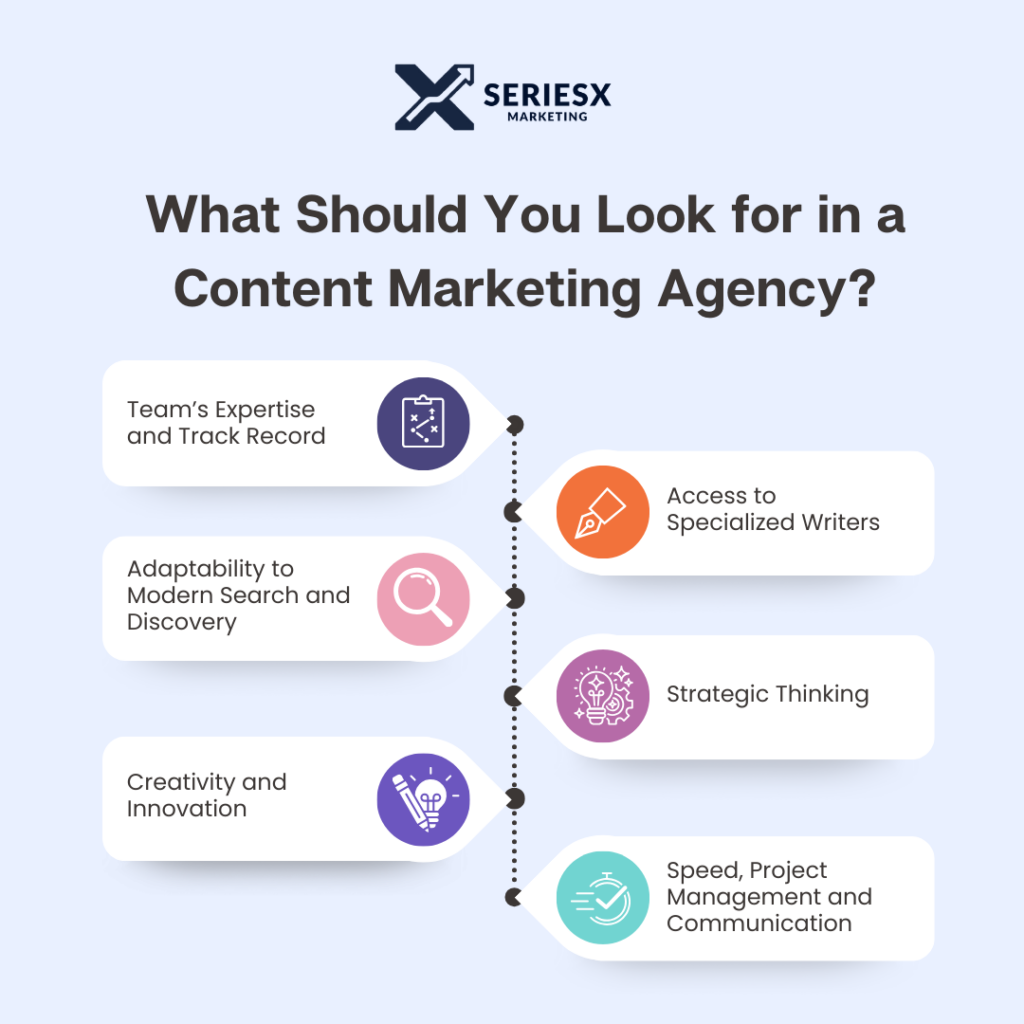
When you’re evaluating external partners to support your goals, the right agency will behave differently from the wrong one from the first conversation. Here are the signals that separate genuine B2B content marketing agencies from content mills dressed up as agencies.
- They ask about your business before they ask about your content. A strong content marketing agency opens with questions about your business model, your ICP, your sales cycle, and your competitive positioning, not your preferred blog format or word count. They understand that the content is a downstream output of strategy, not the other way around.
- They have a defined onboarding process. Not a kickoff call. An onboarding process with a structured intake that captures brand voice, ICP pain points, product positioning, and content gaps before a single brief is written. The absence of this is a strong signal that you’ll be doing that work yourself.
- They report on content-led impact, not just traffic. Pageviews are a vanity metric. A B2B content marketing agency worth working with connects content to pipeline stages by looking at your analytics system, tracks keyword ranking progression, measures content-to-conversion attribution from your CRM, and can speak to how their work is moving buyers through the funnel.
- They have demonstrable B2B marketing/sales depth. General content agencies produce general content. Look for vertical or sector experience in B2B tech with client examples, not just claims. A content marketing agency for SaaS, professional services, or enterprise technology should be able to speak your language from day one.
- They assign dedicated strategists, not rotating writers. The relationship value of an agency engagement lives with the strategist who knows your business. An agency that rotates writers and assigns no dedicated strategic ownership is a managed freelancer pool carrying all the consistency risks of the freelancer model with an additional margin layer.
- They can demonstrate content-to-goal attribution. Ask for examples of how past clients measured content impact. If the answer is traffic and impressions, keep looking. If the answer involves pipeline contribution, sales enablement usage, keyword progression, and inbound attribution, you’re on the right track.
- They push back. A strong content marketing agency tells you when an approach won’t work, when a topic is too thin to be worth publishing, or when a campaign idea misses the mark for your ICP. The absence of pushback isn’t partnership, it’s order-taking, which is exactly what most freelancers do.
The Agency vs Freelancer Question Is Really About ROI, Not Cost
The real question in the agency vs freelancer debate isn’t which option has the lower invoice — it’s which option produces the most value per dollar spent, over the time horizon that matters.
The flexibility of the freelance model is genuinely useful when you’re first starting out or at the pre-seed stage. But that model breaks down at scale. The coordination overhead accumulates, the consistency degrades, and the compound losses from inconsistent publishing can erode the domain authority and brand trust you’re trying to build.
In-house hiring solves the consistency problem but introduces new issues. The ramp time, the scope mismatch, the tenure risk, and the reality that one person cannot own an entire content system are very real risks worth considering. When the right content marketer leaves, the institutional knowledge leaves with them.
A well-run content marketing agency delivers a system. Repeatable, consistent, strategically grounded, and designed to compound in value over time. The retainer stays fixed while the content library grows. The knowledge deepens while the briefs stay sharp. The outputs improve while the management burden on your team goes down.
That’s the right frame for comparing agency vs freelancer vs inhouse content team when you’re trying to scale B2B content. Not which invoice looks smaller, but which model builds returns over time.
Outsourced content marketing or building in-house, the question is the same: which model compounds?
SeriesX Marketing is a specialist B2B content marketing agency helping technology, SaaS, and professional services companies build visibility, authority, and pipeline through expert-led content. We work with a limited number of clients each month.
Get in touch with SeriesX Marketing today.