

You used AI tools for content creation to scale your content engine? Congratulations — your B2B brand now sounds like everyone else.
TL;DR
- AI content tools don’t just speed up production, they pull every output toward the statistical average of their training data, a phenomenon called semantic ablation.
- Content can be grammatically clean but interchangeable with whatever competitors are publishing using the same tools.
- This shows up as entropy decay, where writing that’s easy to predict is also easy to forget.
- AI has raised the floor on content quality (even mediocre content is now clean and structured) but compressed the ceiling — the gap between “bad” and “great” has narrowed.
- The fix isn’t avoiding AI. It’s changing job allocation: let AI handle production work (drafting, repurposing, structure, grammar), and keep humans in charge of authorial work (point of view, lived specificity, editorial risk).
- Brands that let AI set the voice get averaged into the sea of sameness.
- Brands that use AI to scale a genuine point of view stand out, precisely because so few competitors still have one.
In 1906, a statistician named Francis Galton walked into a county fair in Plymouth expecting to be proven right. He’d set up a simple contest: 800 ordinary fairgoers would each guess the weight of an ox. Galton’s hypothesis was that without expert knowledge, the crowd would embarrass itself. The guesses would scatter wildly and the average would be useless.
He was wrong in one of the most instructive ways in the history of statistics.
Individually, most guesses were miles off. But when Galton aggregated all 787 usable estimates, the median landed within nine pounds of the ox’s actual weight of 1,198 pounds, that’s less than 1% error. The crowd, collectively, had outperformed any single expert. What made it work was the presence of outliers. Those extreme, “wrong” guesses pulled against each other and the tension between them is precisely what produced accuracy. Remove the outliers, and what’s left is the same perspective everyone else is publishing.
This mechanism, which was later explored in James Surowiecki’s The Wisdom of Crowds (2004), became a celebrated argument for the power of diverse, independent thinking. But it contains a warning that most people skip past: the aggregation only works when the outliers are present.
Here’s the catch: it only works when people think differently. If everyone arrives at the same answer, the crowd loses the diversity that made it smart in the first place.
Which brings us to your AI-led B2B content marketing in 2026.
The same aggregation dynamic that made Galton’s crowd accurate is now making brands invisible. AI tools for content creation don’t just help you write faster, they pull every output toward the statistical center of everything they were trained on. The outliers like the unexpected ideas and unconventional phrasing, get smoothed away before the piece ever gets published. What remains is the median. Professionally correct but indistinguishable from the median your competitors published this morning.
This is a structural problem, and it has a name: Semantic Ablation
The AI-Safe Middle: Gaussian Distribution and Entropy Decay
According to Ahrefs, 87% of marketers now use AI to help create content. Companies using AI publish 42% more content per month – about 17 articles versus 12 for those who don’t. On paper, that looks like a win. More content, faster, cheaper.
But here’s what that statistic obscures: volume without differentiation isn’t a content strategy. It’s a content landfill.
LLMs are trained on billions of sentences, which means they’ve built an extraordinarily detailed map of how language tends to go. This is called a Gaussian distribution, a bell curve where the most common phrasings are clustered at the center and unusual expressions pushed to the edges. When the model generates or refines text, it gravitates toward that center.
When AI content editing tools “improve” a draft, they don’t just fix grammar. They replace your deliberately odd word choice, the one that felt slightly risky but was doing real work, with something that is statistically safer.
This is semantic ablation at work. The meaning survives. The personality doesn’t. And in a market where every competitor is writing about the same category with the same AI tools, personality is often the only thing separating your brand from theirs.
This is where entropy decay comes into the picture. In information theory, entropy measures unpredictability and the amount of new information you can provide to the readers. High-entropy writing is harder to predict; it catches you off guard with a turn of phrase, a structural choice, an unexpected analogy. Low-entropy writing is easy to skim because you already know what’s coming. AI content writing — even excellent AI content writing — tends toward low entropy over time. It sounds good until you realise that easy reading is forgettable reading. The brain doesn’t work to understand it and it doesn’t work to retain it.
Put all three concepts together, and you get content saturation that isn’t a volume problem, but an architectural one. The tools designed to make your content better are, by design, biased against the exact qualities that make content stick.
This has a measurable, observable consequence. Ask ChatGPT to pick a random number between 1 and 100. It overwhelmingly chooses 73. Not because 73 is random, but because 73 feels the most random based on how humans write about randomness. The model doesn’t know what random means. It knows what “random” looks like in text.
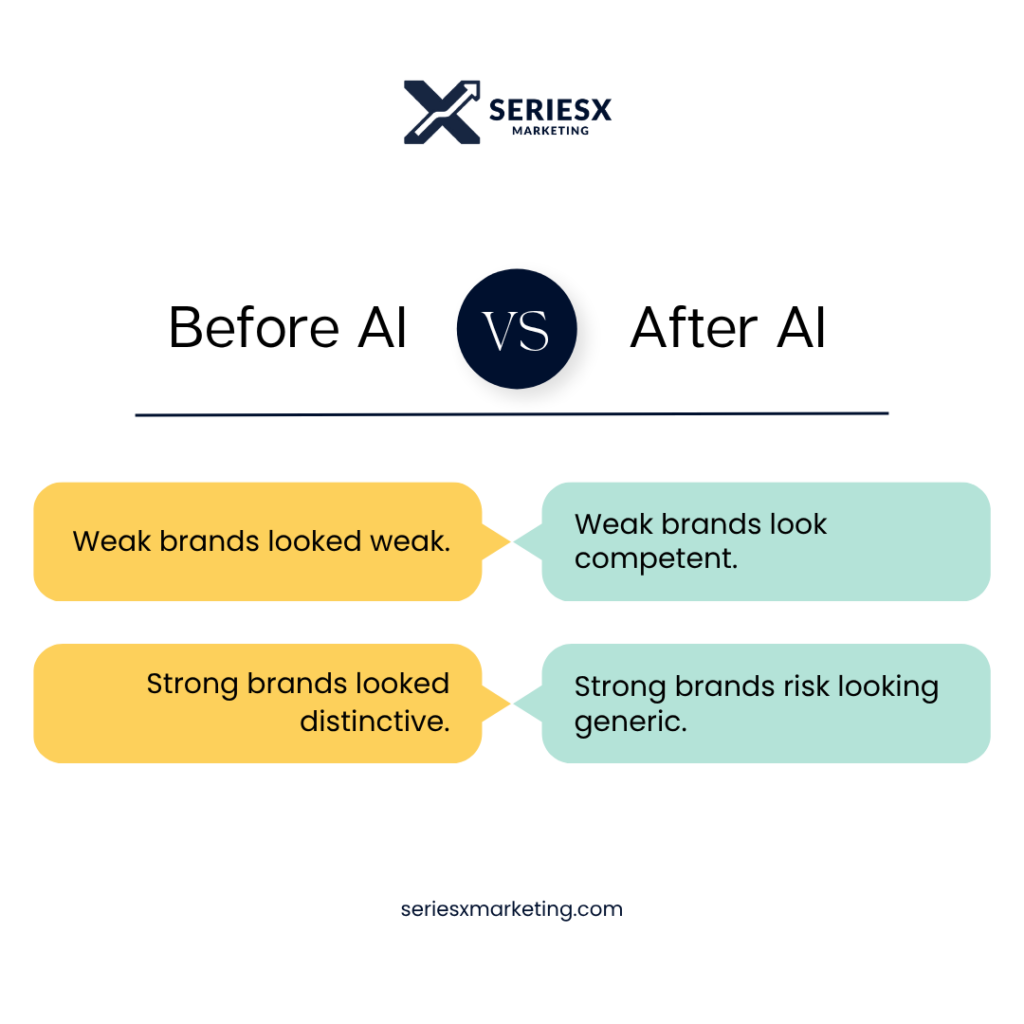
This is the ceiling problem. AI raised the floor and even mediocre content is now grammatically clean and reasonably structured. But by raising the floor, it compressed the quality ceiling. The space between “bad” and “great” has narrowed to a sliver, because the model pulls everything toward the middle.
Bad content was always easy to beat. You could out-quality it. The new threat is something far more insidious: content that is competent, correct, and completely forgettable.
What AI Polish Actually Removes: A Before/After
The easiest way to see semantic ablation in action is to watch it happen to a real piece of writing. The following is an illustrative example of a realistic B2B SaaS company’s original draft paragraph, run through a standard AI content editing pass. The kind of thing that happens thousands of times a day inside marketing teams who use AI-powered tools for content creation to “clean up” drafts before publishing.
Before (original human draft):
“Honestly this is for the ops lead who got burned last time. The one who sat through the demo, heard ‘seamless migration’ about six times, signed off, and then watched the proposed 8-week timeline turn into 5 months while half the team stopped trusting the project. We’re not going to promise seamless because nobody believes that anymore anyway. What we can promise is you’ll actually know what’s happening week to week, which honestly might matter more.”
After (AI polish pass):
“Our solution is designed for operations leaders who have experienced challenges with previous implementations. We understand that migrations can be complex, and our platform provides the transparency and visibility your team needs to keep projects on track and deliver results.”
Notice what changed?
The specific emotional memory of being burned. The “signed on the dotted line”, a legal idiom used informally, which carries weight. The word “quietly” in front of “lost faith.” The deliberate refusal to use “seamless.” The entire rhetorical stance of the brand.
What remained: accurate, professional, and absolutely indistinguishable from the homepage of any other enterprise software company. The AI content analysis pass removed nothing false. It removed everything true about who this brand is.
This is what content authenticity erosion looks like at the sentence level. Multiply it across a year of blog posts, LinkedIn updates, email sequences, and product pages, and you have a brand that has technically been publishing content while quietly eroding its brand.
It’s Not Just Your Copy. It’s Everything You Publish as AI Content.
The homogenization problem would be manageable if it were limited to written content. It isn’t.
The same training-data dynamics that make AI content converge toward sameness apply to AI-generated visuals. Models trained on the same image datasets produce the same compositional choices: the same hero image layouts, the same colour palettes that feel “modern and clean,” the same stock-photo-adjacent aesthetics. The same iconography. The same gradient directions.
Which means a brand isn’t just losing its voice — it’s losing its face simultaneously. When the writing sounds like everyone else’s writing AND the imagery looks like everyone else’s, brand differentiation becomes structurally difficult – because every surface the brand occupies is trending toward the same mean.
This compounds quickly. In any individual content format, convergence is noticeable but manageable. When it happens across every format at once – be it blog posts, LinkedIn posts, email sequences, hero copy, product pages, or white papers – the accumulated effect is brand dilution. Your company exists but the brand just doesn’t register in your audience’s memory.
What Forgettable “AI Content” Actually Costs You
The consequences here are not abstract, and they’re not limited to “engagement metrics.” They hit revenue and trust in measurable ways.
97% of B2B buyers say trust in the vendor is a decisive purchase factor, which makes credibility a bigger differentiator than content volume. And with over 74% of new content published online now being AI-generated, the bar for what counts as trustworthy, distinct content has only gotten higher, meaning the cost of sounding generic is climbing right as buyer scrutiny is too.
And then there’s the search problem. A Semrush study reported by Business Insider found that 37% of marketers say competitors appear more often in AI-generated search results — which means as LLM-powered answers replace traditional SERPs, brands that sound like everyone else are getting averaged out of existence in discovery, too. AI content management systems and AI-powered search rewards genuine expertise and distinct perspective. Statistically probable content gets absorbed into the answer without attribution.
But the biggest cost is one that doesn’t show up in dashboards at all: memory.
People can’t recommend something they can’t quite recall. They can’t champion a brand they can’t describe. Word-of-mouth is still the highest-leverage channel in B2B and requires that someone cares enough about an idea to carry it into a different conversation. Generic AI content produces no such carriers. It enters the brain and exits without leaving a mark.
Brands that become indistinguishable don’t just compete for attention. They compete on price because when buyers can’t perceive a meaningful difference between vendors, cost becomes the only remaining differentiator. That’s a race you don’t want to join.
The Diagnostic: Is Your Brand Already Underwater?
Before arriving at a solution, you need an honest read on where you actually stand. Here’s a short diagnostic. Be honest with your answers.
Could your headline appear unchanged on a competitor’s site? Pull up your last five blog titles. Now Google them. If you’re seeing close variations on page one from direct competitors, you are not differentiating, you are just participating in a trend.
Does your About page use any of these words: passionate, innovative, seamless, cutting-edge, solutions-focused, client-centric? Each of those words has been used so many times they’ve lost semantic content entirely. They occupy space without communicating anything.
If you removed your logo from your last three posts, would anyone know they were yours? This is the ultimate brand-voice test. Voice should be identifiable by feel, not by byline.
When did your content last take a position someone could disagree with? Not a prediction like “AI will transform the industry”. An actual editorial stance, something that implies another position is wrong. Safe content is not what most people engage with.
Do your content briefs start with keywords or with a question your customers are actually asking? One approach produces optimized content. The other produces relevant content.
If three or more of these stung, your brand’s content is already operating in the sea of sameness. The good news: getting out of the AI content slop is a strategic choice, not a resource problem.

Specificity Is the Only Moat Left
AI agents for content creation average what already exists. They cannot fabricate the genuinely specific details that make your content unique to you. The details that have to come from inside your organization, your clients, and your professional experience. That asymmetry is where your brand differentiation lives.
There are four ways to build this specificity:
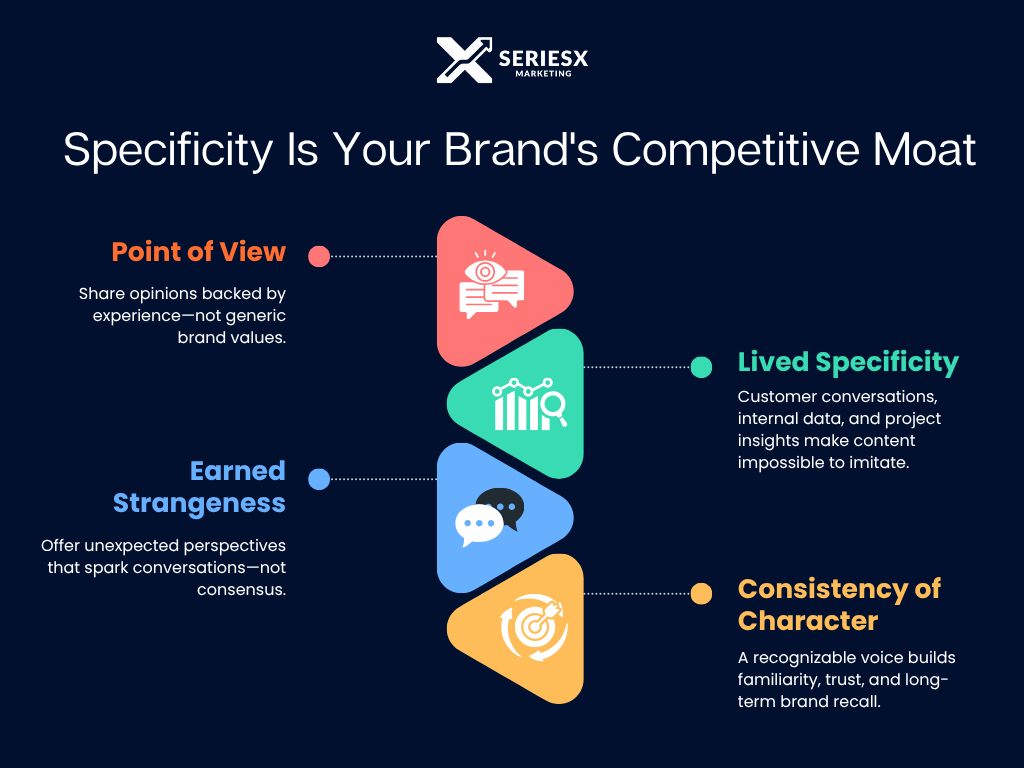
Develop a point of view. If your content sounds like something your competitors could have written, it probably doesn’t have a point of view. A genuine point of view isn’t a mission statement or a list of brand values. It’s a clear position, backed by experience, that you’re willing to defend. Pair that with examples only your company can provide—customer conversations, internal data, and lessons from real client work—and your content becomes something AI can’t easily imitate.
Use lived specificity. The same principle applies to the evidence you use. Instead of relying on generic examples, pull from your own business: the exact words a prospect used in a discovery call, the results of an internal experiment, or the specific issue your team uncovered while fixing a client’s campaign. AI can’t recreate these details because it has never seen them. They’re unique to your business, which makes your content harder to copy and more credible.
This is why the best B2B content marketing strategy involves asking product, customer success and sales teams what language customers actually use and not what feels professional. “Our implementation took 11 months when we were sold 6” is more useful than “enterprises face challenges with time-to-value.” One is a lived experience. The other is a template.
Use earned strangeness. Give readers a reason to remember your content by saying something they haven’t heard before. That doesn’t mean chasing hot takes. It means earning originality through real expertise—sharing an insight, observation, or perspective only your experience can provide.
Content that tries to appeal to everyone rarely sticks with anyone. The pieces people screenshot, share in Slack, or forward to colleagues usually contain an unexpected insight or a fresh way of framing a familiar problem. Not everyone will agree with it, and that’s okay. If your content occasionally loses people because they disagree with your perspective, you’ve probably created something distinctive enough to matter.
Consistency of character. Distinctiveness compounds over time. A brand that shows up with the same voice, the same editorial sensibility, and the same visual character across two years of content builds something that cannot be replicated by AI-powered tools for content creation: familiarity as trust. The reader knows what to expect from you, not what format the content takes, but what stance you’ll bring to any given subject.
This is why content velocity without character is actively counterproductive. More forgettable content faster doesn’t build a brand. It builds a larger forgettable archive.
AI’s Actual Job in the Room
This isn’t an argument against AI content writing or AI content editing in production. It’s a precision argument about job allocation.
AI is genuinely excellent at: production speed, repurposing long-form content into shorter formats, first-draft scaffolding from a detailed brief, SEO structure, headline variants, grammar and clarity passes. These are production tasks, and AI-powered tools for content creation handle them well.
AI causes damage when it’s making the ideas, setting the voice, and taking the creative risks. Those are authorial tasks and they require human inputs that AI doesn’t have – such as your firm’s actual perspective, your clients’ exact frustrations, the argument you’ve been having internally for six months about what your category actually means.
A useful test for any piece of content: who had the idea? Who set the tone? If the answers are both “the model,” your brand is being averaged out one asset at a time. If a human had a genuine position and used an AI tool to develop and distribute it faster, that’s smart AI content marketing: the input is human; the leverage is from AI.
The content marketing trends worth following aren’t about which tools are most powerful. They’re about which brands are using AI tools for content creation to amplify genuinely distinct thinking and which brands are using them to produce sophisticated-looking noise at scale.
The Scarcity AI Content Created
Here’s the inversion, stated plainly: AI made content abundant and originality scarce.
Specific, opinionated, human content was always the answer. AI didn’t change that — it just made the contrast brutal. Generic content is now free to produce at scale, which means the market is flooded with it, and the brands that actually have something to say are harder to find than ever. The value of genuine content authenticity hasn’t gone up because the rules changed. It’s gone up because everything around it got worse. Specific, opinionated, human content is the moat, and therefore the valuable thing.
Genuine content authenticity is more valuable now than at any previous point in marketing history. Not because buyers have changed, they’ve always preferred brands that feel like they have something real to say. But because the contrast with everything else has sharpened so dramatically.
The question isn’t whether your brand is using AI for content.
It’s whether there’s anything in your content that AI couldn’t have produced which is worth saying and adds value to your business and customers.
SeriesX Marketing is a practitioner-led B2B content marketing agency that helps technology, services and SaaS companies build content strategy services rooted in genuine perspective and not statistical probability. If your brand is ready to stop sounding like everyone else, let’s talk.