
TL;DR
- Perplexity searches the live web for every query, so being crawlable and current comes first.
- It cites individual passages, not whole pages, so clear, self-contained answers win.
- Freshness carries more weight here than on most AI engines, but only real updates count.
- PerplexityBot and Perplexity-User follow different crawler rules, and blocks often happen at the firewall layer rather than in robots.txt.
- Pro Search rewards topical depth across follow-up questions.
- No single platform is a guaranteed citation lever for Perplexity, so spread your presence across owned, community, directory and publication sources.
Perplexity SEO is the practice of making your content easy for Perplexity to find, extract and cite. It belongs to the wider world of AI search optimization, alongside answer engine optimization and generative engine optimization. If you want to know how to rank on Perplexity, start with this: there is no list of blue links to climb. You are either one of the sources it cites, or you are invisible.
The channel is still small. Statcounter’s March 2026 data put Perplexity at 7.07% of AI chatbot referrals to websites, down from a 12.07% peak in April 2025, now behind Gemini (8.65%) and well behind ChatGPT (78.16%). But it is volatile and unusually transparent, because every answer carries numbered Perplexity citations you can inspect. That makes it the easiest engine to audit, and a smart place to start building AI visibility.
What Is Perplexity SEO, and How Does Perplexity Work?
Unlike other LLM models, Perplexity is an answer engine, not a chatbot.
So instead of replying from training data, Perplexity AI runs a live web search for most queries, then writes an answer with numbered citations linking to the pages behind each claim.
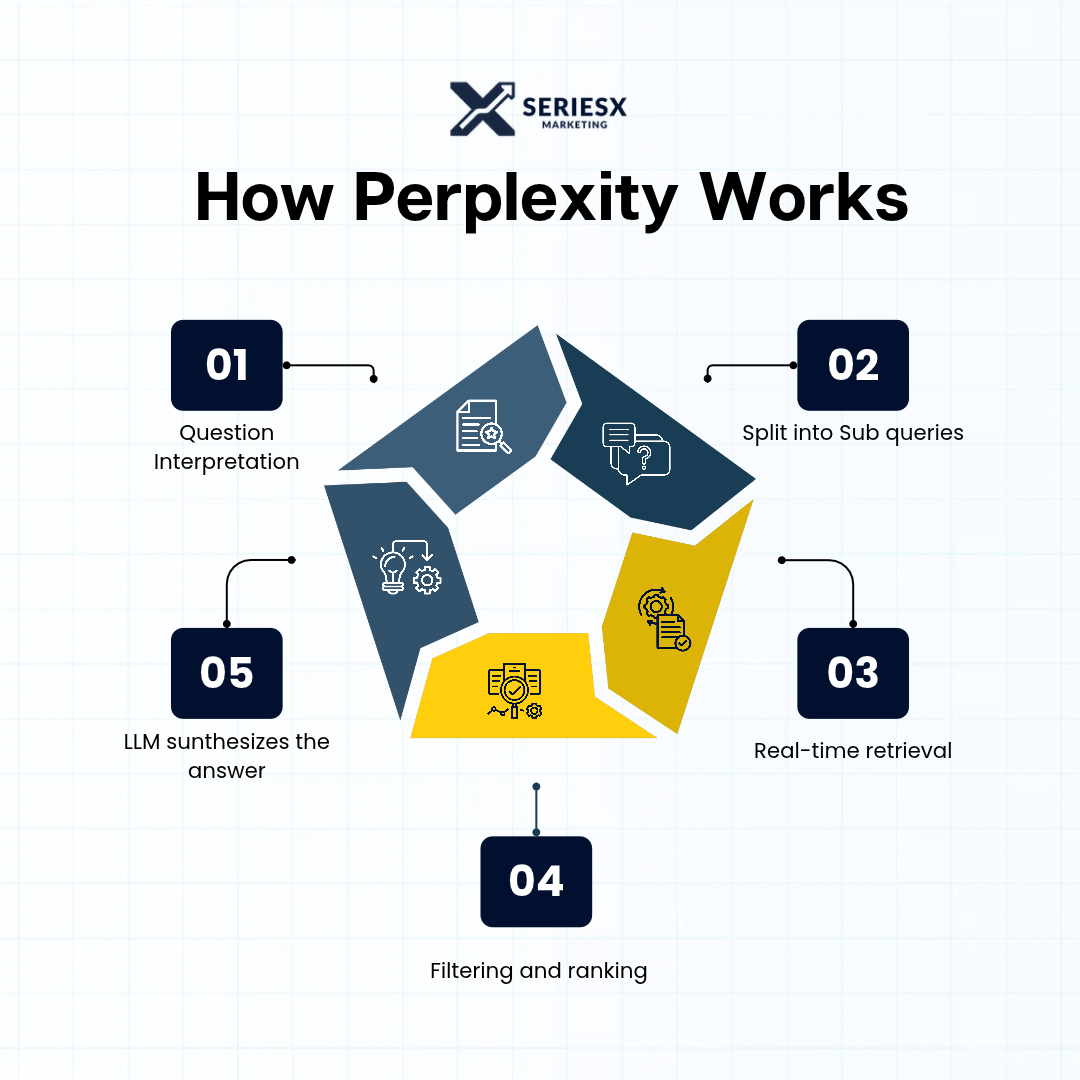
The process has four steps:
- Perplexity interprets the question and often splits it into sub-queries
- Retrieves candidate pages in real time
- Ranks and filters them
- Then has a language model synthesize the strongest passages into an answer
It doesn’t publish its citation formula, so the commonly cited signals (relevance, freshness, authority, and clarity) are observed patterns, not confirmed weights. Treat any ranking-factor percentage with caution.
How does Perplexity work in each mode? The depth of that process changes with the search mode you choose:
| Mode | What it does |
| Best | Default for quick searches; automatically selects a model |
| Pro Search | Runs multiple searches and compiles insights from many more sources |
| Research | Runs dozens of searches and reads hundreds of sources to produce a report |
Two crawlers also matter, and they follow different rules, according to Perplexity’s crawler documentation:
| Crawler | Purpose | Honors robots.txt | Why it matters |
| PerplexityBot | Surfaces and links sites in Perplexity search results | Yes | Block it and your pages can’t be surfaced |
| Perplexity-User | Fetches a page when a user’s question needs it | Generally no | Serves live, user-initiated visits |
Security layers can block crawlers before robots.txt is even read, so a good idea is to check your CDN and firewall as well.
Where Does Perplexity Pull Its Citations From: Reddit, Wikipedia, Quora, or Somewhere Else?
As it is for other AI answer engines, it depends on the question being asked in Perplexity. Objective, factual queries lean on websites, while subjective ones, such as comparisons and recommendations, pull community discussions, review platforms, and specialist directories.
Ahrefs analyzed over 3.1 million US Perplexity queries in September 2026 and found Reddit (21.6%) and YouTube (20.8%) at the top of its most-cited websites.
For B2B, LinkedIn matters too. Semrush’s analysis of 325,000 prompts (January to February 2026) found Perplexity cites LinkedIn in 5.3% of responses, and 59% of those citations point to Company Pages. Goodie’s analysis of B2B SaaS citations from February to June 2025 points the same way. Reddit topped Perplexity’s list, and LinkedIn appeared in its top ten but in no other model’s.
Reddit and YouTube are frequently cited by Perplexity, but their reported shares vary widely between studies, so treat any single figure as a snapshot. Quora sits in the same community category and is tracked less consistently.
The takeaway for your AI search visibility is to spread your presence across your own site, community platforms, directories and trade publications rather than betting on one.
Why Do Freshness and Passage-Level Clarity Matter More on Perplexity?
Two things set Perplexity apart from other AI search surfaces, and both shape how to rank on Perplexity.
First, it retrieves live information, so stale pages lose ground. Ahrefs found that AI assistants tend to cite content that is 25.7% fresher than the URLs in traditional organic results, and the effect is strongest on time-sensitive topics.
Second, Perplexity cites passages, not pages. One clear paragraph can earn a citation even if the rest of the page is average, and a long article can be skipped if its answer is buried. That is why citable content is built from self-contained sections.
One caution: changing a publish date without changing the content doesn’t count as an update.
How to Rank on Perplexity SEO (An Actionable Framework)
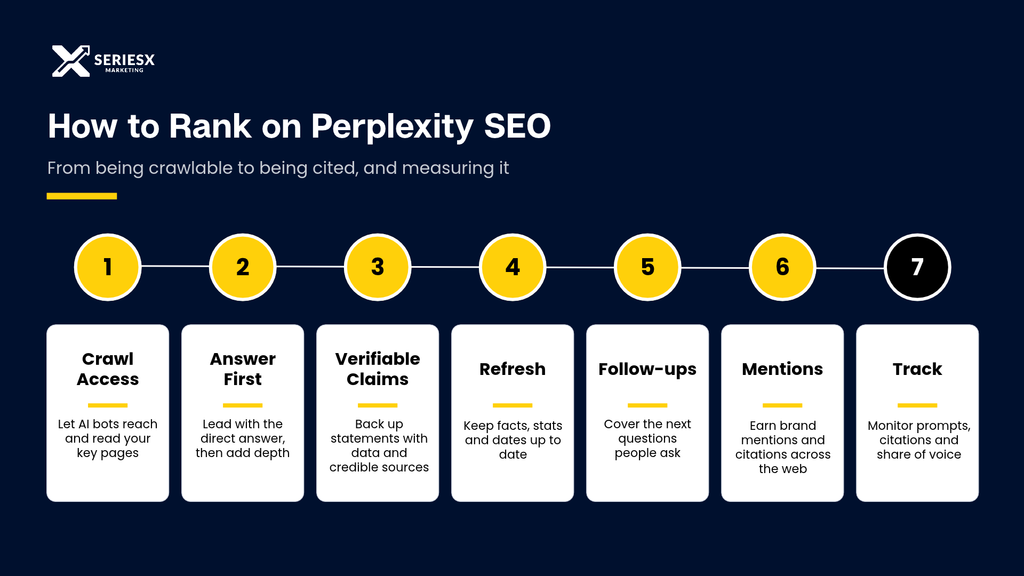
Here is the step-by-step framework on how to get cited by Perplexity:
1. Make sure PerplexityBot can reach your pages.
If PerplexityBot can’t crawl a page, it can’t surface or cite it. Check robots.txt, CDN settings, firewall rules and security plugins, then confirm visits in your server logs. Add Perplexity’s published IP ranges on allow lists, and serve key content as server-rendered HTML, not heavy client-side JavaScript.
2. Write answer-first sections.
Open each section with a question-style heading and a direct one or two sentence answer, then add context. Keep every paragraph self-contained so it still makes sense when lifted out. This structure underpins any AEO strategy and wider LLM optimization.
3. Make every claim verifiable.
Perplexity attaches citations to claims, so give it claims it can check. Use specific numbers with named sources, link to primary sources, show named authors and publish original, first-party data where you can. A Princeton-led study on generative engine optimization found that adding statistics or direct quotations lifted AI visibility by 30 to 40%.
4. Refresh on a regular cadence.
Update priority pages monthly or quarterly with real edits, show a visible “last updated” date and keep dateModified accurate in your schema. A steady publishing and refresh rhythm compounds over time, which is where content velocity comes in.
5. Cover the follow-up questions.
Pro Search runs multiple searches and keeps context for follow-ups, so build topical authority with a hub page and focused supporting pages. Surfer’s analysis found that ranking for sub-queries made content 49% more likely to be cited than ranking for the main query alone, and ranking for both made it 161% more likely to appear in AI answers.
6. Earn mentions where Perplexity already looks.
Run your target questions in Perplexity and list the non-competitor domains it cites: forums, review sites, directories and trade publications. Then contribute genuinely useful content there. Brand mentions matter. Ahrefs’ study of 75,000 brands found that web mentions correlated with AI Overview visibility at 0.664, versus 0.218 for backlinks.
7. Track citations manually.
Perplexity has no Search Console equivalent and doesn’t share its own platform visibility data, so tracking takes legwork. Run 20 to 30 target prompts monthly in standard and Pro Search, segment perplexity.ai referrals in GA4 and check PerplexityBot activity in server logs. Also review how you’re cited, since Perplexity can occasionally misquote a source. This is the baseline for any AI search marketing programme.
Perplexity SEO vs. Citations on other AI Search Engines
Each AI engine sources answers differently, so one playbook won’t cover them all. Treat SEO for Perplexity and wider AI search SEO as related but separate jobs. For a full breakdown, you can see our other guides:
| Platform | Primary Crawler(s) | Key Source Types Favored | Dedicated Guide |
| Perplexity AI Search | PerplexityBot, Perplexity-User | Community and experience-driven content, review platforms, industry directories, recent authoritative publications | This guide |
| ChatGPT Search | OAI-SearchBot, GPTBot, ChatGPT-User | Reference/encyclopedic, community/forums, news, general web search | ChatGPT AI Search |
| Google AI Search | Googlebot | YouTube, Reddit, Wikipedia, official/brand sites, news and publisher backlinks | Google AI Search Optimization |
| Bing Copilot AI Search | Bingbot | First-party sites, reference sources, community platforms, editorial/media | Bing AI Search |
Perplexity SEO Rewards Fresh, Passage-Ready Content, Not Just Strong Rankings
There are three factors to focus on if you want to get cited on Perplexity:
- Perplexity’s referral share is shifting. It fell from a 12.07% peak in April 2025 to 7.07% in March 2026 as per Statcounter, so build visibility across engines instead of relying on one.
- Source mix is engine-specific. In a 1,739-citation B2B study, YouTube and Reddit citations came only from Perplexity.
- Freshness is a real edge. AI assistants cite content 25.7% fresher than organic results.
Perplexity AI SEO builds on strong fundamentals instead of replacing them. Earning AI citations comes down to being crawlable, quotable, and mentioned in the right places.
Where SeriesX Marketing comes in: this is the kind of work we do for B2B tech companies, building content that holds up whether you’re cited in Perplexity, surfaced in an AI Overview, or grounded in Copilot, and tuned for AI SEO and LLM SEO alike.