
When a buyer asks Claude which vendors to consider for their category and use case, there is no page one to compete for. Claude searches the web, pulls in a handful of trusted sources and gives one answer with minimal citations. Being one of those citations is part of the new discipline of AI search visibility.
The audience is already large and growing. Claude.ai recorded 950 million visits in August 2026, up from 148 million a year earlier, with 111 million unique visitors.
That is what Claude SEO is about: making your content easy for Claude to find, extract and cite. It sits within AI and LLM SEO, but the rules differ from traditional SEO: there is no index to submit to, Search Console platform equivalent, or grounding query data to learn from.
The visitors are also worth winning. In one 2026 B2B benchmark, referrals from Claude converted at 16.8%, the highest of any AI engine tracked and about six times Google organic’s 2.8%.
This guide covers how Claude search works, which crawlers decide whether you can be cited, where Claude citations come from, and how to optimize for Claude at each stage of retrieval.
TL;DR
- Claude SEO means making your content eligible to be retrieved, extracted and cited when Claude searches the web. Only live search can cite you, because answers from training data carry no link.
- Anthropic runs three crawlers. Blocking ClaudeBot only affects training, while citations depend on Claude-SearchBot and Claude-User, so a blanket AI-bot block can remove you from Claude search.
- A Google ranking doesn’t guarantee a Claude citation. Anthropic’s subprocessor list names Brave Search as a web-search provider, and Profound found 86.7% overlap with Brave’s top results, though from a sample of just 15 results. Make sure you’re indexed in Brave Search.
- Each Claude citation carries up to 150 characters of cited text, so open your sections with the answer and write self-contained, quotable sentences under question-led headings.
- Claude is extremely selective about which sources it cites. It processes enormous amounts of content but cites very little of it, favouring the most factually accurate, well-sourced pages on a topic. To earn AI citations, publish data-rich content with specific numbers and clear attribution, which performs better than general-purpose content.
- Team and Enterprise owners can turn off web search, and API admins can restrict domains, so third-party coverage matters when live retrieval never runs.
How Claude Finds and Chooses Its Sources
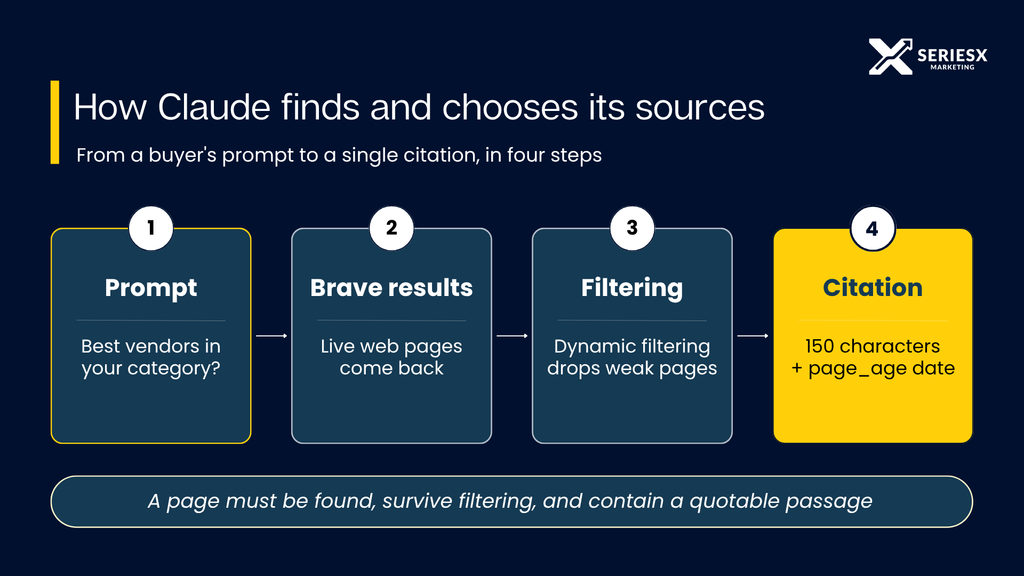
Claude answers from training data or from live Claude AI search (powered by the Brave Search API). It decides whether to search based on the prompt, and it doesn’t always do so: one test reported searches on 36.6% of prompts, versus roughly 90% for ChatGPT. It searched most often when prompts signalled freshness, rankings, location or comparison intent, and rarely for “what is” or “how does” questions. A buyer asking for the best vendors in your category is exactly the kind of prompt that sends Claude to the web.
How Claude Filters and Cites Results
Once results come back, the newer web search tool version supports dynamic filtering. Each citation then carries up to 150 characters of the cited content, plus a page_age field recording when the site was last updated. The implication is that a page must be found, survive filtering, and contain a short passage worth quoting.
Where Claude Citations Come From
Claude is extremely selective about what it cites. It processes enormous amounts of content, but its citation rate is very low: it looks for the most factually accurate, well-sourced content on a given topic. Data-rich content with specific numbers, a named methodology and clear attribution performs significantly better than general-purpose content. In the Princeton-led GEO study, adding statistics, cited sources and quotations produced the biggest visibility gains, up to 40%, although that study wasn’t Claude-specific.
Claude sources cluster into long-form editorial publications, reference sites such as Wikipedia and Wikidata, research and government sources, review platforms and first-party sites. Platform-level evidence is thin and mostly vendor-published, so read it as directional.
- Reddit and Quora: One Q1 2026 analysis put Claude’s social citation rate at 3.99%, the lowest of the major engines, with Reddit under-indexed. A Reddit-heavy playbook built for Perplexity or other AI engines probably transfers poorly, and Quora likely follows the same pattern.
- Wikipedia: The evidence is mixed. A study of 83,670 citations saw Claude cite Wikipedia only twice, leaning on company blogs, research firms and vendor documentation. Use Wikipedia and Wikidata for consistent entity data where you qualify, not as a citation shortcut.
Claude AI search rewards depth and credentials over volume. The same study found Claude most likely to cite brand websites directly, at 22.2%, which makes your own primary sources and authoritative sources count.
Is Claude SEO Different from Google SEO?
The fundamentals between Claude SEO and Google SEO overlap: crawlability, content quality, authority and E-E-A-T.
The difference is the output.
Google SEO ranks ten links and measures clicks.
Claude synthesises one answer from several sources, so AI citations and mentions replace rankings and clicks. Retrieval is also multi-step, with follow-up searches that pull different angles, which rewards pages that fully answer one sub-question. That is why AI search SEO and classic SEO compound rather than compete.
Claude vs. Other AI Search Engines
Each search engine sources differently, so one playbook won’t cover them all. Treat Claude SEO and wider AI search SEO as related but separate jobs. For a full breakdown, see our other guides:
| Platform | Primary Crawler(s) | Key Source Types Favored | Dedicated Guide |
| Claude AI Search | Claude-SearchBot, Claude-User | First-party brand sites, company blogs and vendor documentation, long-form editorial and research sources, with community platforms cited less | This guide |
| Perplexity AI Search | PerplexityBot, Perplexity-User | Community and experience-driven content, review platforms, industry directories, recent authoritative publications | Perplexity AI Search |
| ChatGPT Search | OAI-SearchBot, GPTBot, ChatGPT-User | Reference/encyclopedic, community/forums, news, general web search | ChatGPT AI Search |
| Google AI Search | Googlebot | YouTube, Reddit, Wikipedia, official/brand sites, news and publisher backlinks | Google AI Search Optimization |
| Bing Copilot AI Search | Bingbot | First-party sites, reference sources, community platforms, editorial/media | Bing AI Search |
Which Claude Crawlers Decide Whether You Can Be Cited?
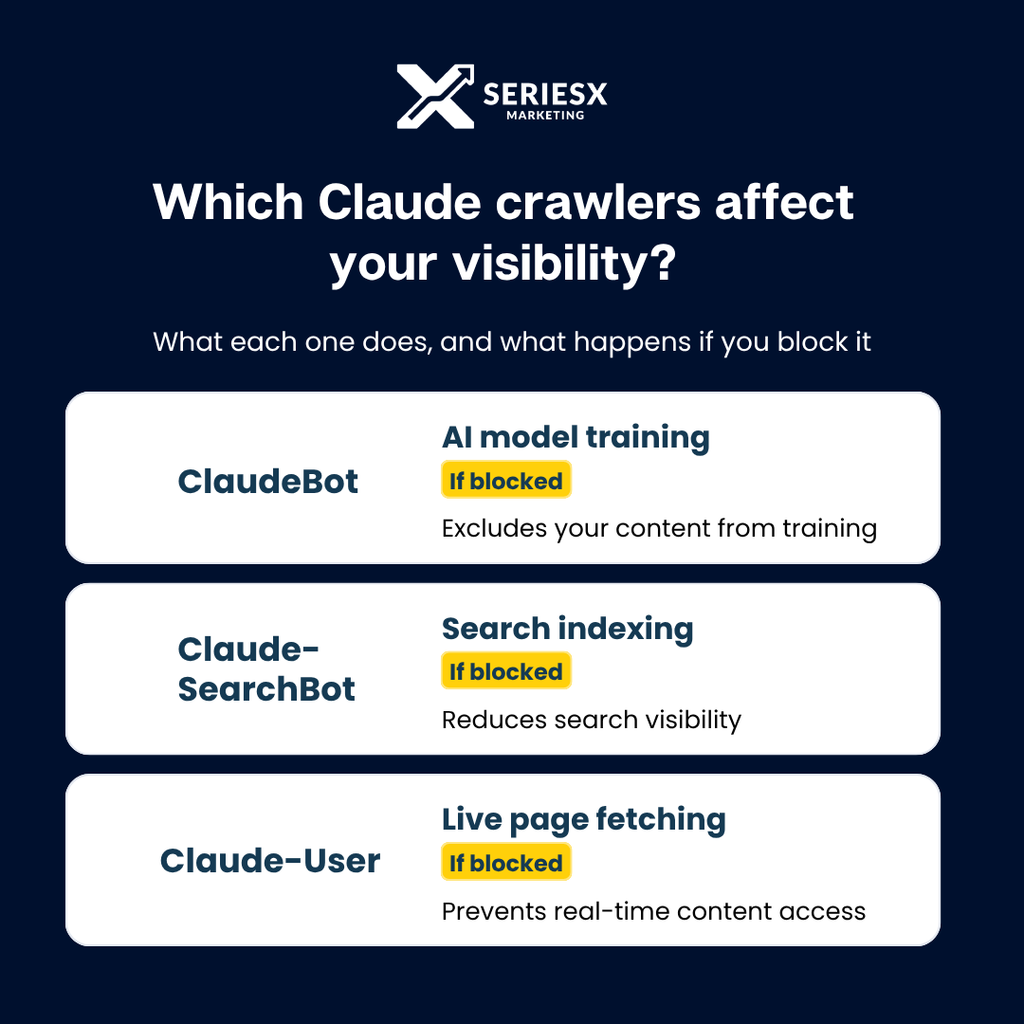
Anthropic runs three bots, each with its own robots.txt token:
| Bot | What it does | If you block it |
| ClaudeBot | Collects content that may feed model training | Opts you out of training only |
| Claude-SearchBot | Indexes pages for Claude’s search | Can reduce your visibility in search results |
| Claude-User | Fetches pages when a user asks about them | Stops live fetches of your pages |
The common mistake is pasting a blanket AI-bot block. Blocking ClaudeBot has no effect on citations, which depend on the other two bots, and Anthropic itself warns that blocking Claude-SearchBot may reduce visibility.
A safer robots.txt setup is to block training if you wish and allow search and user fetches, like below:
| User-agent: ClaudeBotDisallow: / User-agent: Claude-SearchBotAllow: / User-agent: Claude-UserAllow: / |
Three gaps to watch out for:
- Each subdomain needs its own robots.txt.
- Anthropic warns that IP blocking may not work as an opt-out.
- CDN rules can override your robots.txt. One analysis of the top 2,000 sites found 136 (8.9%) allow AI crawlers in robots.txt but appear to block them at the edge.
| To verify, check your server logs for 200 responses to Claude-SearchBot and Claude-User. |
Claude SEO for Enterprise Buyers: Three Checks Before Your Content Is Read
Many B2B users sit behind controls you can’t see.
- Gate 1: Team and Enterprise owners can turn off web search for Chat in Organization settings.
- Gate 2: For API users, an administrator must enable web search in the Claude Console, and developers can restrict searches with allowed_domains.
- Gate 3: Winning retrieval is the only gate you control.
For readers behind Gates 1 and 2, training-data presence and third-party sources matter more, because live retrieval may never run. Since citations are always enabled for API web search, one well-cited page can surface in many tools built on it.
How to Optimize for Claude SEO: A Framework Built Around Each Stage of Retrieval
Claude’s retrieval runs in stages: pages are crawled and indexed, results are filtered, a passage is extracted, and a source is cited. Each step below maps to one stage. Work through them in order, because polishing your author bios won’t help if a firewall is blocking the crawler. This AEO strategy is also the practical answer to how to rank on Claude.
1. Allow Claude-SearchBot and Claude-User to Access Your Site
Eligibility comes first. Confirm your robots.txt allows both Claude-SearchBot and Claude-User, since each has its own robots.txt token. Then check that no CDN, firewall or bot-management rule is blocking them behind the scenes, and use your server logs and hosting support team to confirm they receive 200 responses.
Serve your key content as server-rendered HTML. Text that only appears after JavaScript runs can be missed by AI crawlers that don’t execute scripts. Also make sure every important page is reachable through internal links, optional llms.txt, and listed in your XML sitemap.
Finally, get indexed beyond Google. Anthropic’s subprocessor list names Brave Search as a web-search provider, so search for your priority pages in Brave and fix any that are missing.
2. Write Answer-First Sections With Question-Led Headings
Newer versions of Anthropic’s search tool support dynamic filtering, so a page that buries its answer risks being passed over. Open every section with the direct answer in the first one or two sentences, then add the supporting detail.
Write headings as the questions buyers actually ask, such as “How much does a content audit cost?” instead of “Our pricing approach”. These mirror the follow-up queries Claude runs. Keep one topic per page: a page that covers five topics gives a filter no clear reason to keep it for any of them.
3. Write Quotable Sentences That Earn Claude Citations
Each citation holds up to 150 characters of the cited content, which is roughly 25 words. Every load-bearing claim, whether a definition, a statistic or a recommendation, should therefore work as a standalone sentence. It should name the subject instead of leaning on “this” or “it”, state the claim, and include the date or source.
An illustrative before and after:
- Weak: “Our process is faster than most, as covered above.”
- Strong: “Our onboarding takes 14 days on average, based on 120 client launches completed in 2025.”
Dates matter beyond the sentence itself. Citations also record a page_age field showing when the site was last updated, so refresh key pages and show visible update dates. The 25-word guideline is editorial advice, not an Anthropic rule.
4. Publish Original Data for Citation-Worthy Content
Claude can find the same generic advice on hundreds of pages, so it has little reason to cite yours. Citation-worthy content offers something others can’t: original data such as survey results or benchmarks, a documented methodology (sample size, dates, how you measured), and claims qualified honestly (“in our sample of 80 accounts” rather than “always”).
Your own pages count as primary sources. One analysis of 83,670 citations found Claude most likely to cite brand websites directly, at 22.2%. Depth beats volume, so publish fewer, stronger pages. Pair them with our guides on content marketing statistics and content velocity, and build a cluster of related pages to strengthen topical authority.
5. Name the Expert and Add Person Structured Data
Put a named author on every article, with a short bio, real credentials and links to their professional profiles. Add Person structured data (name, jobTitle, sameAs) and Article markup with author, datePublished and dateModified.
Anthropic hasn’t said Claude reads structured data, so treat it as clarity for every crawler rather than a guaranteed lever. The visible credentials do the real work, because they give a reader, and a model, a reason to trust the page.
6. Keep Your Entity Consistent With sameAs Links and Wikidata
Describe your company the same way everywhere: your site, LinkedIn, review platforms, and press boilerplate. Use the same name, category, and one-sentence description, and connect them with sameAs links in your Organization markup.
Maintain Wikipedia and Wikidata entries only where you meet their notability rules, and never write your own page. The evidence is mixed on how much Wikipedia matters for Claude, since one study saw Claude cite it just twice. Treat it as an entity-clarity signal, not a citation shortcut.
7. Earn Third-Party Brand Mentions to Build Topical Authority
Claude’s answers draw on third-party sources as well as yours, and many enterprise readers never trigger live search at all. Coverage elsewhere helps in both cases so prioritize:
- Industry and editorial publications, through expert commentary or contributed articles.
- Review platforms, by asking happy customers for detailed reviews.
- Comparison and roundup articles in your category.
- Original research that others quote and link to.
These build brand mentions and authoritative sources around your name. Don’t over-index on forums: one analysis found Reddit under-indexed on Claude relative to other engines.
How to Track Claude Citations and Measure Claude SEO
There is no first-party citation report, so build your own system and run it monthly.
Build a fixed prompt set.
Write 15 to 30 prompts the way buyers phrase them: category questions, “best X for Y” queries, and problem-led questions and comparisons. Keep the wording identical each month. Record whether Claude searched, which sources it cited, whether you appear and how it describes you.
Separate search from non-search answers.
Claude doesn’t always search. One test reported searches on 36.6% of prompts. Answers without a search carry no citations, so track whether you’re mentioned and how accurately you’re described too.
Track comparison prompts as their own group
Queries like “X vs Y” and “alternatives to X” signal active vendor evaluation, so any movement there matters more than in broad category prompts.
Check your server logs.
Filter for the Claude-SearchBot and Claude-User user agents. Look at which pages they request, whether they get 200 responses and whether activity rises after you publish or update a page. Claude-User hits suggest a person asked Claude about that specific URL.
Measure referral traffic.
Check sessions from Claude in your analytics tool, along with landing pages and conversions. Expect undercounting, since analytics setups often lump AI referrals into organic, direct or other buckets.
Ask buyers directly.
Add an AI assistant option or question such as “how did you hear about us”, with a free-text field for which one.
Over time, watch these four numbers: citation frequency, share of mentions against competitors, referral sessions, and accuracy. Accuracy means whether Claude describes your services, pricing and positioning correctly. When it doesn’t, fix the source pages, then retest. That audit, update and retest loop is how you monitor Claude AI visibility over time.
Claude SEO Mistakes to Avoid
- Pasting a blanket AI-bot block. Teams copy a rule meant to stop training and unknowingly remove themselves from Claude search. Blocking ClaudeBot only affects training, while citations depend on the search and user bots. Block training if you must, but allow the other two, and don’t rely on IP blocking, which Anthropic warns may not work as an opt-out.
- Assuming Google or Bing rankings transfer. A strong Google position in SEO doesn’t guarantee a Claude citation in AEO. Profound found 86.7% overlap between Claude’s citations and Brave’s top results, from a small sample, so check how you perform in Brave too.
- Writing long pages that cover many topics. Citations pull short excerpts, and filtering favors focused pages. Split sprawling guides into one page per question and link them together.
- Running a Reddit-heavy ChatGPT playbook on Claude. Participating credibly in communities is fine, but one analysis put Claude’s social citation rate at 3.99%, the lowest of the major AI search engines. Put your main effort into your own pages and editorial coverage.
- Publishing anonymous bylines and thin posts at volume. That study saw Claude draw on company blogs, research firms and vendor documentation, which points to depth and expertise. A stream of unsigned, unsourced posts adds little for source attribution to work with. Publish fewer posts, name the expert behind each one, and include original data.
Claude SEO Rewards Accessible, Quotable Content
There are three things to focus on if you want to get cited in Claude AI search:
- Eligibility comes first. Anthropic warns that blocking Claude-SearchBot may reduce your visibility in search results, and one analysis of the top 2,000 sites found 136 (8.9%) that allow AI crawlers in robots.txt but appear to block them at the edge.
- Extraction is narrow. Each Claude citation carries up to 150 characters of cited text, so your key claims need to work as standalone sentences.
- Trust comes from your own pages and the right mentions. Claude cited brand websites directly 22.2% of the time in an analysis of 83,670 citations, while its social citation rate was just 3.99%, the lowest of the major engines (tryanalyze.ai; Everything PR).
Where SeriesX Marketing comes in
This is the kind of work we do for B2B tech companies. We build content that holds up whether you’re cited in Claude, surfaced in an AI Overview, or grounded in Bing/Copilot, tuned for AI SEO and LLM SEO alike.