

TL;DR
- AI Overviews and AI Mode are not the same target. They cite different sources 86% of the time despite semantically similar answers — only 13.7% citation overlap.
- Ranking #1 on SEO doesn’t guarantee an AI Overview citation. Only 38% of cited pages rank in Google’s Top 10; even #1 pages are cited roughly only half the time.
- Citations come from a wider ecosystem than the SERP — YouTube, Reddit, Quora, Wikipedia, and publishers all factor in, not just ranked web pages.
- Gemini powers three surfaces (the Gemini app, AI Mode, and AI Overviews), all grounded in Google’s live index — meaning classic SEO carries more weight here than on other AI platforms.
- The framework: answer fast, build entity authority, target conversational queries, create original citable data, stay fresh, diversify formats, and keep core SEO fundamentals intact.
Google AI Search, also called Google generative AI search, refers to the two AI-powered layers now built into Google Search: AI Overviews and Google AI Mode. They generate synthesized answers above a traditional list of blue links. Together, these surfaces already reach a massive share of search traffic: AI Overviews now serve 2.5B+ monthly active users, and AI Mode has crossed 1B+ monthly active users. For B2B marketers, that scale means AI Search optimization is a fresh opportunity and should be included in the current roadmap.
The good news is that AI Search on Google is still fundamentally built on strong SEO. The challenge is that the citation ecosystem is broader than traditional rankings, and getting cited in one AI surface doesn’t guarantee visibility in the other.
What Is Google AI Search, and How Do Google AI Overviews Differ from AI Mode?
Google AI Overviews are the short, summary-style answers that appear above traditional organic results for many queries. They’re designed for quick, scannable answers.
AI Mode is Google’s conversational, Gemini-powered search experience, built for multi-turn, research-style queries rather than single-shot answers. AI Mode responses run about 4x longer than AI Overview responses, and AI Mode query volume has more than doubled every quarter since launch, making it one of the fastest-growing surfaces in Search. Because of this length and conversational format, AI Mode SEO requires a noticeably different approach than optimizing for a short summary box.
If you’re building out a broader AI Search Optimization strategy, these two surfaces need to be treated as related but distinct targets.
| AI Overviews | AI Mode | |
| Format | Short summary | Conversational, ~4x longer |
| Query growth | Steady | Doubling every quarter |
| Entity mentions | Lesser entity mentions | 2.5x more brand/entity mentions |
| Best for | Quick factual queries | Complex, multi-part research |
Does Getting Cited in Google AI Overviews Mean You’ll Also Appear in AI Mode?
Not necessarily. Despite the two surfaces producing semantically similar answers 86% of the time, the citation overlap between AI Overviews and AI Mode is only 13.7%, and word overlap sits at just 16%. In other words, the two systems are pulling from largely different source sets to arrive at similar conclusions.
Part of the explanation is that AI Mode surfaces 2.5x more brand and entity mentions than AI Overviews — it’s simply citing more sources per response, which spreads visibility more widely across brands.
There is some correlation between the two: a brand cited in AI Overviews has roughly a 61% chance of also appearing in AI Mode. That’s a meaningful signal, but it’s correlation, not causation..
| The practical takeaway is that ranking or getting cited in one surface like AI Overviews does not guarantee visibility in another like AI Mode, so brands need to optimize for both independently rather than assuming success in one carries over. |
Where Does Google AI Search Get Its Sources?
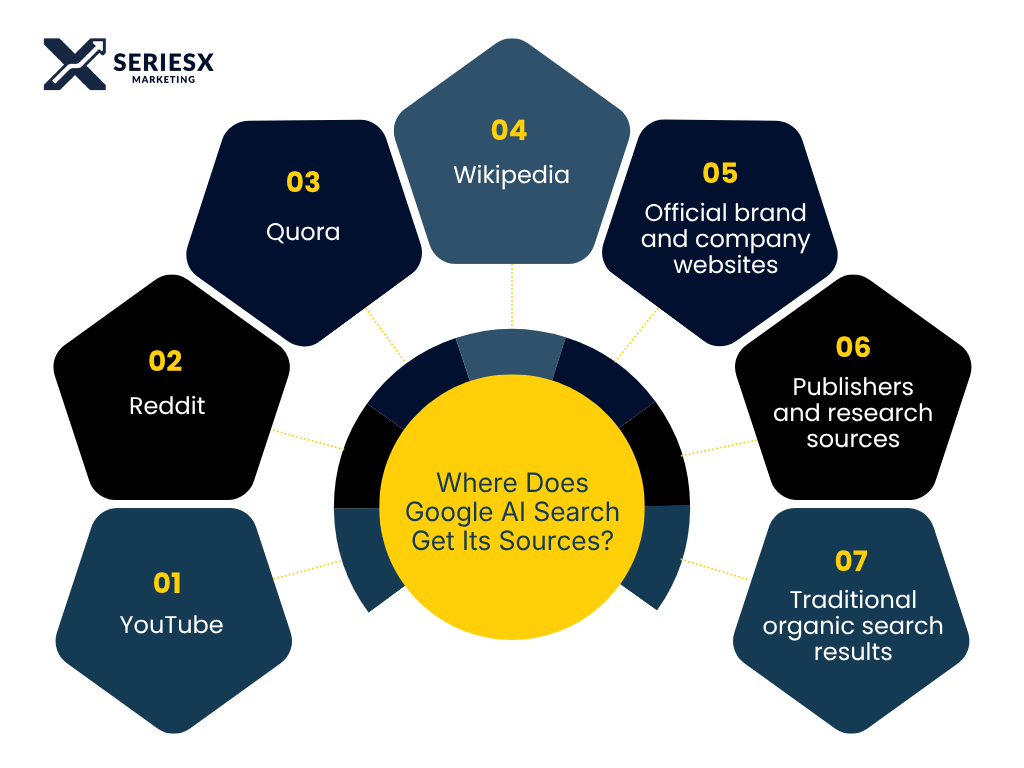
Both AI Overviews and AI Mode draw from a wide content ecosystem, not just top-ranking web pages:
- YouTube
- Quora
- Wikipedia
- Official brand and company websites
- Publishers and research sources
- Traditional organic search results
| This diversity is one of the biggest shifts marketers need to internalize as part of any Google AI search SEO strategy: strong SEO is necessary, but Google’s AI layers are pulling citations from well beyond the traditional Top 10. |
How Google AI Overviews Specifically Selects Sources
Google AI Overviews pull from Google’s own index and lean heavily on E-E-A-T signals (Experience, Expertise, Authoritativeness, and Trustworthiness). They now appear in roughly 70% of Google searches for B2B tech-related queries, making them the more ubiquitous of the two surfaces.
What sets AI Overviews apart is that they already inherit your traditional SEO signals (backlinks, page authority, topical relevance), but layer an additional preference on top: content with cited sources and structured data. Including authoritative citations in your content correlates with a 132% visibility boost, and writing in an authoritative, non-salesy tone adds another 89% on top of that.
Importantly, AI Overviews don’t just recycle the Top 10. Only about 15% of AI Overview sources overlap with conventional organic rankings: meaning a page that wouldn’t crack page one in traditional SEO can still get cited, provided it has strong structured data and clear, extractable answers.
Where to focus:
- Schema markup is the single biggest lever (Article, FAQPage, HowTo, and Product schema) give AI Overviews structured context to work with (a 30–40% visibility boost on its own)
- Build topical authority through content clusters with strong internal linking
- Include named, sourced citations in your content, not just unsupported claims
- Author bios with real credentials matter, since E-E-A-T is weighted heavily
- Get into Google’s Knowledge Graph where possible: an accurate Wikipedia entry helps
- Target “how to” and “what is” query patterns, since these trigger AI Overviews most often
Where Does Gemini Fit Into All Of This?
It’s important to separate two things people often confuse as one: Gemini the model, and Gemini the app.
Gemini is Google’s underlying AI model, and it powers three separate surfaces:
- The standalone Gemini app (which crossed 900 million users following Google’s 2026 I/O announcements),
- AI Mode, and
- AI Overviews.
All three rely on what’s known as Gemini grounding, meaning they anchor their answers in live Google Search results AND Google’s search index, rather than relying purely on the model’s training data.
This has a practical implication for marketers: the most direct path to visibility across all three Gemini-powered surfaces is still ranking well in classic Google Search.
This makes Gemini visibility more tightly coupled to traditional SEO than it is for other AI platforms like ChatGPT or Perplexity, which rely on separate, independently-crawled indexes.
Gemini-powered surfaces run on Googlebot infrastructure. In practice, this means a page that’s properly indexed by Google doesn’t require a separate technical push to be crawlable for Gemini, AI Mode, or AI Overviews – that already gets taken care of.
One nuance you might miss: Google-Extended is a separate robots.txt control that lets site owners opt their already-crawled content out of Gemini model training and grounding specifically, without affecting Search rankings or AI Overviews eligibility. It’s a permissions toggle sitting on top of Googlebot’s crawl, not a separate crawler in its own right.
Does Ranking #1 in Google SEO Guarantee an AI Overview Citation?
In one word: No.
Google AI search ranking doesn’t work the way traditional Top 10 ranking does. The data here is one of the clearest proof points for why Google AI Overviews SEO is a distinct discipline from traditional SEO. Only 38% of pages cited in AI Overviews also rank in Google’s Top 10. Ahrefs’ broader correlation analysis found just a moderate relationship between top-10 ranking and AI Overview citation with pages ranking #1 being cited in AI Overviews only around half the time.
That said, SEO fundamentals clearly still matter: the median URL cited in an AI Overview previously ranked around #3 in traditional SERPs, showing that strong organic performance meaningfully improves your odds of citation even if it doesn’t guarantee it.
How to Optimize for Google AI Search? (An Actionable Framework)
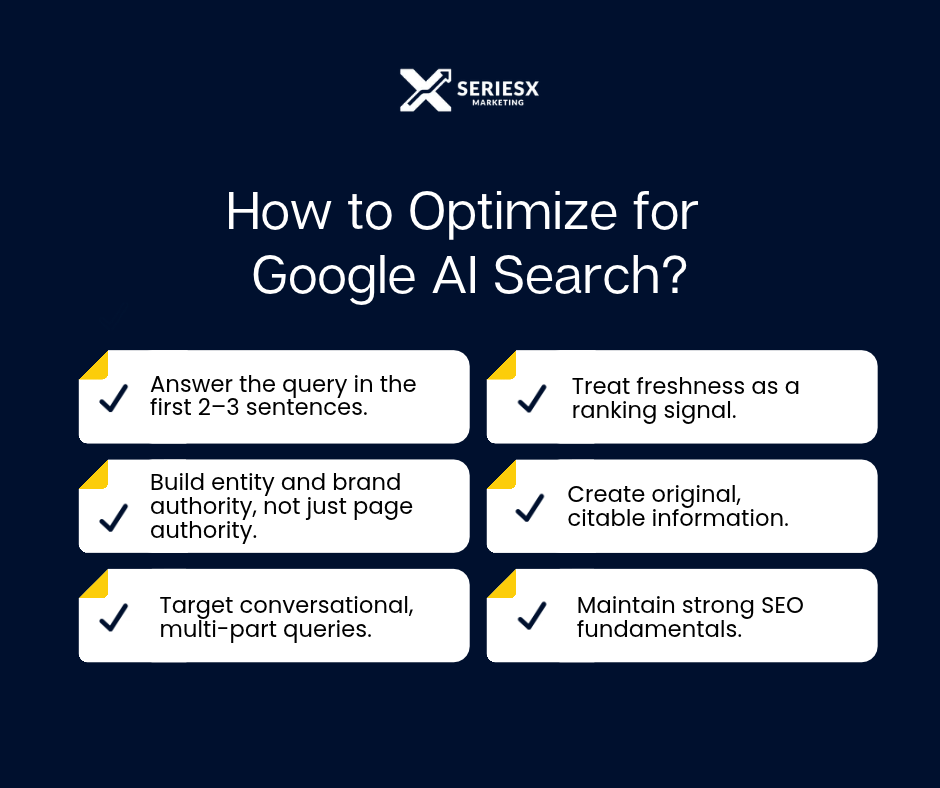
The framework below pulls together the levers that actually move the needle if you want to optimize for Google AI Overviews or optimize for AI Mode, and Gemini-grounded surfaces: from how you structure an answer to the technical groundwork that keeps your content crawlable in the first place.
- Answer the query in the first 2–3 sentences. Both AI Overviews and AI Mode favor content that states a direct answer up front, before expanding into supporting detail. Lead with the answer, not the setup.
- Build entity and brand authority, not just page authority. Given that AI Mode surfaces 2.5x more brand mentions than AI Overviews, being a recognized, consistently-referenced entity across the web, and not just having one well-ranked page, increasingly determines whether you show up at all.
- Target conversational, multi-part queries. AI Mode users ask queries nearly 3x longer than traditional searches. Content built around single keywords will increasingly miss the mark; structure content to answer layered, natural-language questions.
- Create original, citable information. AI Overviews and AI Mode both favor content that is extractable like a stat, a finding, or a named data point, rather than content that only synthesizes what’s already out there. If your page is the source others end up citing, it’s also the page these systems are more likely to pull from directly.
- Treat freshness as a ranking signal. Both surfaces favor recently updated content for time-sensitive topics, hence a page with stale stats is easier to skip than one that’s visibly current. Revisiting existing pages and refreshing them, not just publishing new ones, keeps you eligible for citation as facts shift. This is also where Content Velocity comes in, since a consistent publishing and refresh cadence compounds your odds of citation over time.
- Diversify content formats. With 18% of non-ranking AI Overview citations coming from YouTube alone – and YouTube mentions showing the strongest correlation (0.737) with overall AI search visibility of any off-site signal – video, structured data, and FAQ content all extend your surface area for citation beyond your core web pages.
- Maintain strong SEO fundamentals. Don’t abandon Top 10 rankings, they still meaningfully correlate with citation odds. Pair this with consistent backlinks and a strong brand entity presence (accurate “sameAs” signals) across the web to reinforce authority in Google’s eyes.
SEO Is Necessary, Not Sufficient for Google AI Search
Here’s the pattern running through everything that actually drives Google AI search visibility: every assumption that used to say:
- rank #1 and you’re covered,
- win one AI surface and you’ve won them all,
- “AI search” is one thing to optimize for,
turns out to be wrong once you look at the data. Google’s own AI layers behave less like an extension of the SERP and more like a handful of separate ecosystems that happen to share a search bar.
That’s not a reason to abandon SEO — it’s still the foundation everything else sits on. Winning visibility across AI Overviews, AI Mode, and Gemini means treating each as its own target: its own sources, citation logic, and reasons to trust a brand enough to name it.
Where SeriesX Marketing comes in
This is exactly the kind of work we do for B2B companies — building content and entity authority that holds up whether you’re cited in an AI Overview, surfaced in AI Mode, or grounded in Gemini.